
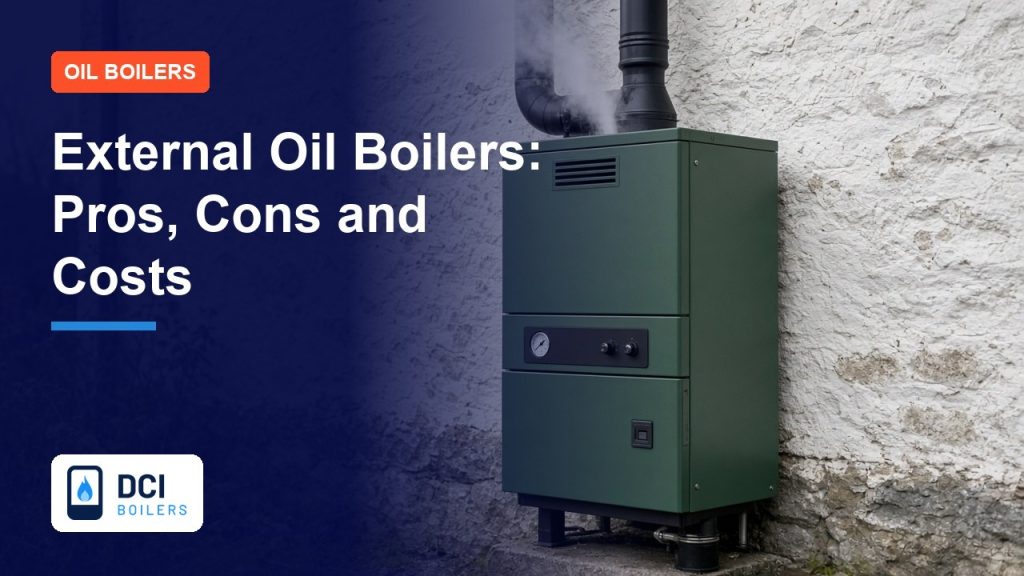
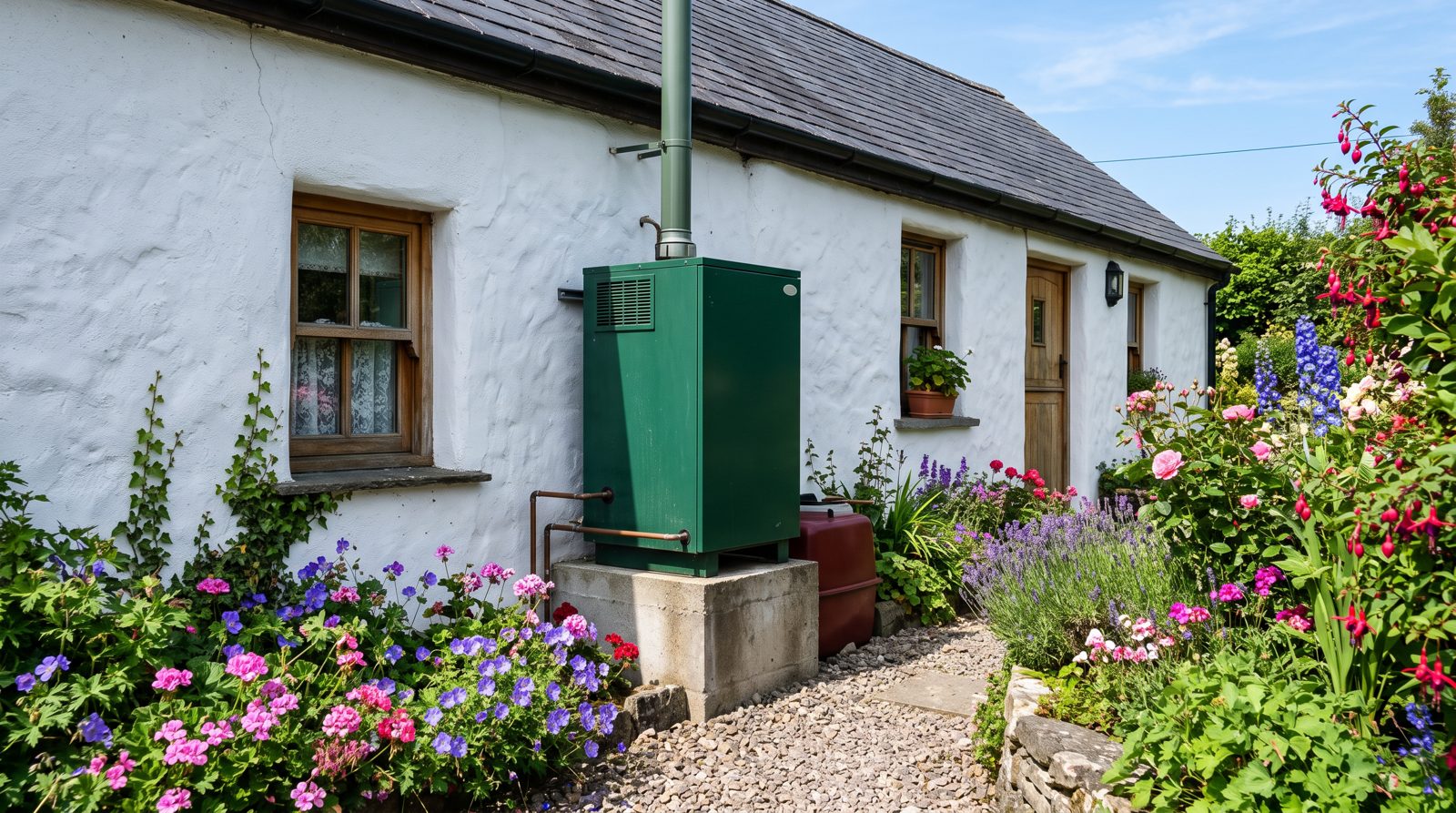
An external oil boiler is a fully weatherproofed unit that lives outside your house, usually on a base against an outside wall, instead of taking up a chunk of your kitchen or utility room. Everything else works the same: it burns heating oil from your tank, heats your radiators and hot water, and needs the same annual service. The appeal is obvious in the compact cottages and older properties common across Cornwall and Devon, where indoor space is precious and a floor-standing boiler is a real sacrifice.
External models are a genuinely good answer for many homes, but they are not automatically the right one. Here is the honest picture: the pros, the cons, and what the costs look like in broad terms.
The case for an external oil boiler
You get your room back
This is the big one. Oil boilers are floor-standing appliances, larger than the wall-hung gas combis people picture, and in a small kitchen the footprint hurts. Move the boiler outside and you free a full cupboard-sized space for storage, appliances or worktop. In a kitchen refit, taking the boiler out of the room often transforms what the design can do.
The noise goes outside too
Oil burners are noisier than gas burners; that low rumble on firing is normal, but it is noticeable indoors, especially in open-plan spaces or when the boiler shares a wall with a living room or bedroom. Outside, the sound largely becomes someone else’s problem, and modern cased units are reasonably quiet anyway. One caveat: think about where the boiler sits relative to bedroom windows and your neighbour’s boundary, because an early-morning firing cycle under the wrong window undoes the benefit.
Fumes, flues and simplicity
With the boiler outside, combustion happens outside. There is no flue running through the building, no plume from a wall terminal by the back door, and no need to design flue routes around bedrooms and openings, which in some properties is the difference between an easy installation and an awkward one.
Easier, cleaner servicing visits
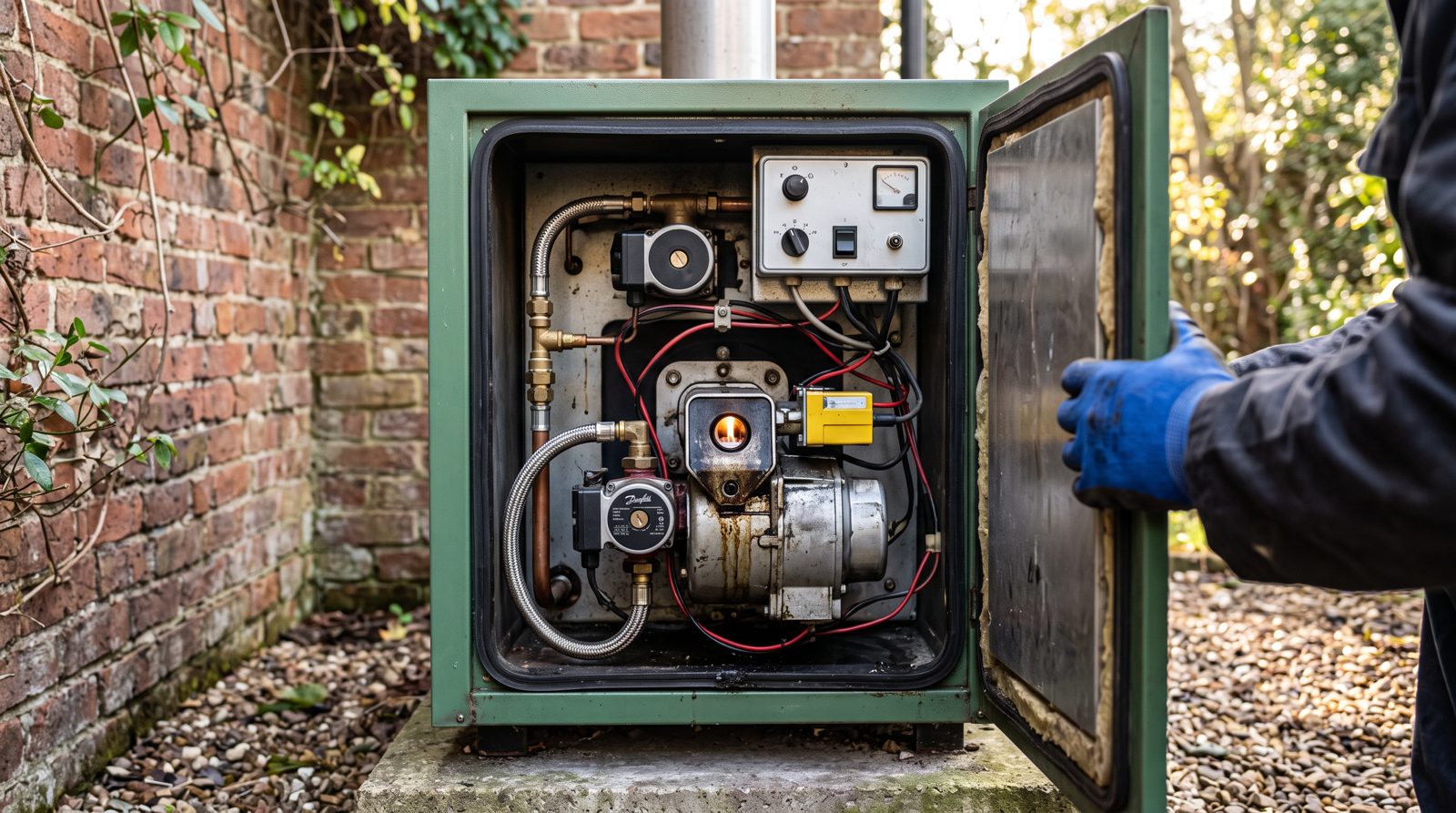
The engineer works at the unit outdoors: no dust sheets through the hallway, no crouching in a cupboard, and better access all round. Annual boiler servicing on an external unit is generally a straightforward job, provided the boiler was sited with working room around it.
The case against
Frost is the enemy
An outdoor boiler and its pipework live in the weather, and a hard frost is the main risk. External boilers are built for this, with insulated casings and built-in frost protection that fires the burner or circulates water when temperatures drop. But that protection depends on the boiler having power and oil, so a winter power cut or an empty tank leaves the system exposed. Exposed pipe runs between boiler and house must be properly insulated and trace-heated where necessary, and this is where corner-cutting installations get found out. Cornwall and Devon winters are mild by national standards, but frosts still come, and coastal wind chill is real.
Weathering and lifespan
Casings are galvanised and painted to shrug off rain, but an outdoor unit simply endures more than an indoor one: damp air, salt in coastal locations, UV, and temperature swings. Kept serviced, external boilers last well, though it is fair to say the environment works against them in a way a dry kitchen never does. Siting the boiler with some shelter, and keeping the casing sound, makes a difference.
Servicing happens in the weather
The access is easier, but it is outdoors in January if a fault strikes mid-winter. More practically for you, any controls on the boiler itself are outside, so a system with good indoor controls, a programmer and room thermostat, matters more than it does with an indoor unit.
Slightly lower efficiency in the cold
An outdoor boiler loses a little more standing heat to its surroundings than one indoors, and it works from a colder start. Modern insulated casings keep the penalty small, but as an honest accounting it exists.
What do external oil boilers cost?
Treat any precise figure with caution, because the honest answer depends on your property, the model and what the installation involves. As a rough guide, external oil boilers tend to cost somewhat more to buy than the equivalent internal model, because you are paying for the weatherproof casing and frost protection. Installation costs vary with the groundwork: a level base, power supply, insulated pipe runs into the house and the oil line from the tank. Where an external unit replaces an internal one, there can be offsetting savings indoors, and the kitchen space you reclaim has a value of its own. Most homeowners find the total lands somewhere near a comparable internal installation once everything is counted, but the only number worth planning around is a fixed quote for your actual house, which we provide free and without obligation as part of every oil boiler replacement survey.
Is an external oil boiler right for your home?
It is a strong choice if indoor space is tight, if your current boiler’s noise or flue position causes problems, or if a renovation would have to design around an indoor unit. It is a weaker choice if there is no sheltered spot with power and drainage nearby, if the only viable position is under a bedroom window or hard against a neighbour’s boundary, or if your property already has a sensible boiler space indoors that you do not need back. A site visit settles it quickly, and both formats are covered in our guide to oil combi boilers if you are also weighing how your hot water should work.
How DCI Boilers can help
DCI Boilers installs internal and external oil boilers across Cornwall and Devon from our base near Saltash, with OFTEC registered engineers, fixed upfront pricing and up to 12 year manufacturer warranties on the boilers we fit. We will look at your property, talk through both options honestly and quote a full oil boiler replacement either way, including the base, pipework, insulation and frost protection done properly. Existing external boiler misbehaving? Our boiler repairs team can help with that too.
Need help now? Call DCI Boilers on 07888 862 603 or get a free quote.
Frequently asked questions
Do external oil boilers freeze in winter?
They are designed not to. External boilers have insulated casings and built-in frost protection that runs the burner or pump when temperatures drop. The protection relies on power and oil being available, and on connecting pipework being properly insulated, so installation quality matters.
Are external oil boilers noisy?
They make the same burner noise as an internal oil boiler, but outside the house it is far less intrusive. Sensible siting away from bedroom windows and neighbouring boundaries keeps the noise from being a nuisance to anyone.
How long does an external oil boiler last?
With annual servicing, typically a similar working life to an internal oil boiler, commonly 10 to 15 years. Outdoor conditions, particularly salt air on the coast, work the casing harder, so keeping up with servicing and keeping the cabinet sound both help.
Can an external oil boiler be a combi?
Yes. Several manufacturers make external oil combi boilers, which heat hot water on demand without a cylinder. They suit smaller households with decent mains pressure, and they pair the space saving of an outdoor unit with the space saving of losing the cylinder.