
Ask ten heating engineers to name the best oil boiler and you will get some strong opinions, but the honest answer is that “best” depends on your home. The best oil boiler for a four-bedroom farmhouse with two bathrooms is not the best one for a two-bedroom cottage. What you can do is understand what separates a good oil boiler from a mediocre one, and then choose a well-proven model that fits your property.
Around here that question matters more than in most of the country. Large parts of Cornwall and Devon are off the gas grid, so oil is still the workhorse fuel for thousands of rural homes. When your boiler is the only source of heating and hot water and the nearest gas main is miles away, reliability stops being a nice-to-have.
This guide covers the qualities worth paying for, the brands with genuine track records, and the practical questions to settle before you buy.
What makes a good oil boiler
Modern oil boilers are all condensing by law, and the leading models are broadly similar in headline efficiency. The differences that matter day to day are elsewhere.
- Efficiency in real use. A condensing oil boiler recovers heat from its flue gases that older boilers threw away. To get that benefit you need the boiler sized and set up correctly, because an oversized boiler short-cycles and never settles into its efficient condensing mode. A well-chosen smaller boiler often outperforms a big one on paper.
- Build quality and longevity. Oil boilers tend to be simpler and more robust than their gas cousins, and a good one, properly serviced, can run for a long time. Heat exchanger quality and the standard of the burner are what you are really paying for in a premium brand.
- Serviceability. This is the one buyers overlook. An oil boiler needs an annual service without fail, because the burner needs cleaning, the nozzle needs replacing and the combustion needs checking with an analyser. A boiler with good access, sensible layout and widely available parts is cheaper to look after for its whole life. Ask your installer which models they find easy to work on, because that answer affects every service bill you will ever pay.
- Parts and support. A brand with a strong UK parts network means a breakdown in January is fixed in days, not weeks. Obscure imports can leave you waiting for components.
- Warranty backing. Look at the length of the manufacturer warranty and, just as importantly, whether the manufacturer has a reputation for honouring it without a fight.
Internal, external or utility: where should it live?
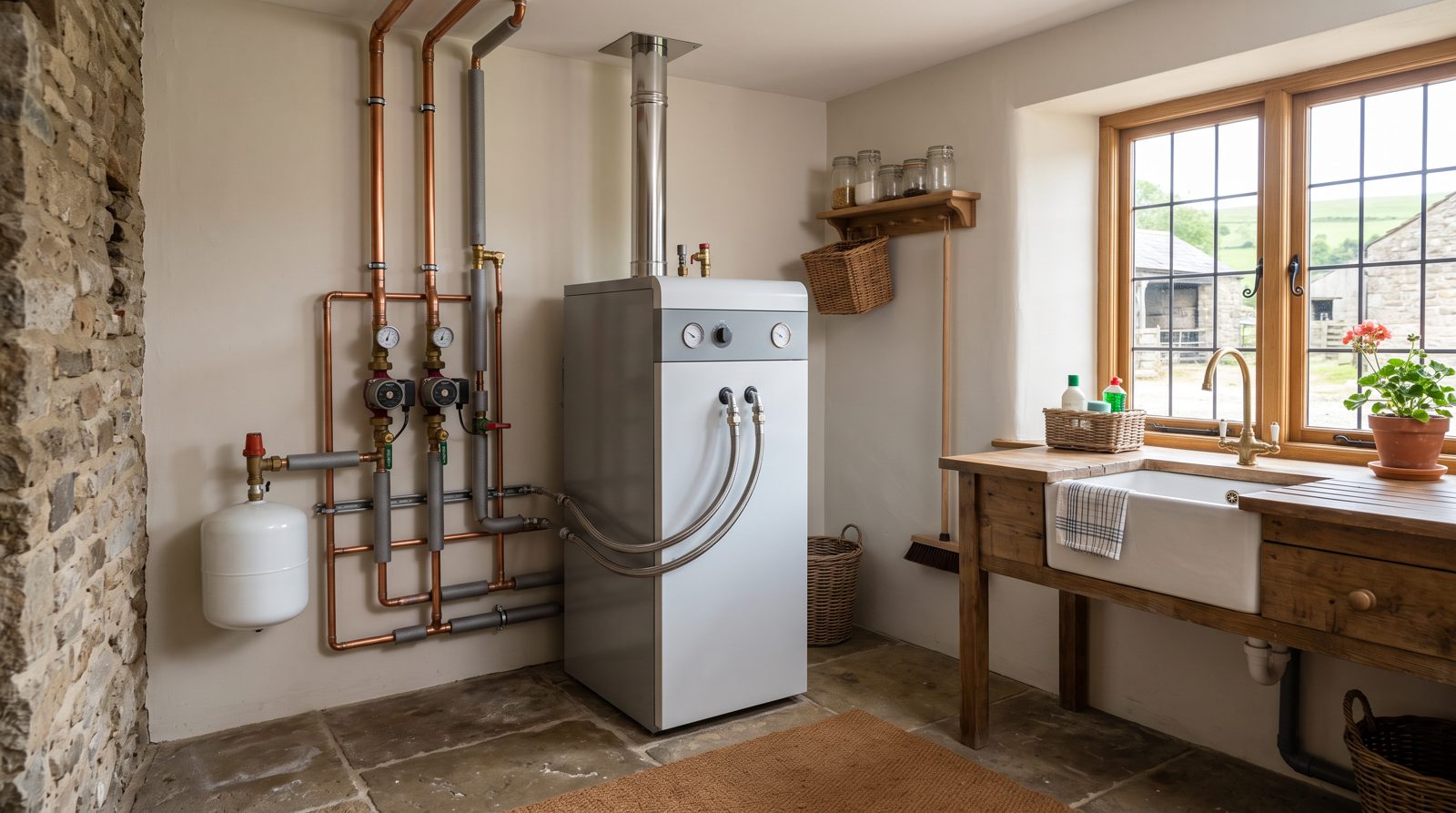
One genuinely useful feature of the oil boiler market is the range of external models. An external oil boiler sits outside in its own weatherproof casing, which frees up space in the kitchen or utility room, keeps burner noise out of the house and makes servicing less disruptive. For cottages and older rural properties where indoor space is tight, an external boiler is often the neatest answer.
Internal models still make sense where there is a utility room or garage to house them, and they avoid the slightly higher heat losses of an outdoor unit. Kitchen-fit models with quieter burners exist for homes with nowhere else to put one. There is no universally right answer, which is why a proper survey matters more than a brochure.
You will also choose between heat-only, system and combi configurations. Most rural homes with a hot water cylinder are best served by a heat-only or system boiler, which suits multiple bathrooms and works well with the water pressures found in off-grid properties. Oil combis exist and can suit smaller households, but they are bulkier than gas combis and worth discussing with an engineer before committing.
Brands worth trusting
We are deliberately not going to publish a ranked top five with invented scores, because those lists are mostly marketing. What we can tell you is which manufacturers have earned solid reputations among the engineers who install and service their boilers across the South West.
- Grant is probably the name most oil engineers mention first. Its Vortex range is a familiar sight across Cornwall and Devon, with a wide choice of internal, external and utility models and a strong parts network.
- Worcester Bosch is best known for gas but has a long-standing oil range too, backed by the same national support that made its name.
- Firebird is an Irish manufacturer with deep roots in oil heating and a good spread of models for rural homes.
- Warmflow and Navien also have established followings, and other reputable names exist besides.
The differences between the leading brands are smaller than the difference between a good and a bad installation. A mid-range boiler fitted carefully, sized correctly and commissioned properly will outlast and outperform a premium boiler thrown in badly. Choose the installer with as much care as the boiler.
Questions to settle before you buy
- Has anyone done a proper heat loss calculation, or just matched the old boiler’s size?
- Is your oil tank in good condition, sited legally and worth keeping? A boiler replacement is the natural moment to check.
- Would an external model free up space you would value?
- What warranty does the installer’s accreditation unlock, and what servicing does it require?
- Is the installer OFTEC registered? For oil work this is essential, both for safety and for self-certifying the installation.
How DCI Boilers can help
DCI Boilers is OFTEC registered and installs oil boilers across Cornwall and Devon, from Bodmin Moor farmhouses to coastal cottages. We survey your home properly, recommend a boiler that fits it rather than a one-size-fits-all favourite, and give you a fixed price up front. Our oil boiler replacement service covers the full job, including removal of the old boiler, and manufacturer warranties of up to 12 years on qualifying installations. Once it is in, our boiler servicing keeps the warranty valid and the burner running cleanly, and if you ever need us urgently our emergency boiler call-out service runs 24/7.
Need help now? Call DCI Boilers on 07888 862 603 or get a free quote.
Frequently asked questions
How long does an oil boiler last?
A good quality oil boiler that is serviced every year can reasonably be expected to last 15 years or more, and plenty go well beyond that. The service matters: an unserviced burner runs dirty, wastes oil and wears components early.
Is oil heating being banned?
No. Government policy on off-grid heating has shifted several times, and earlier proposals to restrict new oil boiler installations were rowed back. You can still replace an oil boiler with a new one, and a modern condensing model will use noticeably less fuel than a boiler from the 2000s. If policy changes in future it is expected to apply to new installations, not boilers already in place.
Are external oil boilers reliable in bad weather?
Yes. External models are built for it, with weatherproof casings and frost protection, and they cope fine with South West winters. They should still be sited sensibly, with reasonable access for servicing and some shelter from driving rain where possible.
Should I replace my oil tank at the same time as the boiler?
If the tank is old, single-skinned or showing wear, it is usually cheaper and less disruptive to do both jobs together. We will always check the tank as part of a boiler survey and tell you honestly whether it has years left in it or not.