
A boiler installation certificate is the document that proves your boiler was installed and commissioned in line with the Building Regulations. For a gas boiler it is issued through the Gas Safe Register after your engineer notifies the job, and it normally arrives in the post or by email within a few weeks of the installation. For an oil boiler the equivalent certificate comes through OFTEC. It is often called a Building Regulations Compliance Certificate, and it is the piece of paper a solicitor will ask for when you sell the house.
Confusingly, a new boiler comes with more than one document, and people use “certificate” to mean any of them. This guide explains what each one is, who issues it, where it should be, and what to do if it has vanished into a drawer somewhere between two house moves.
The three documents a new boiler comes with
1. The Benchmark commissioning checklist
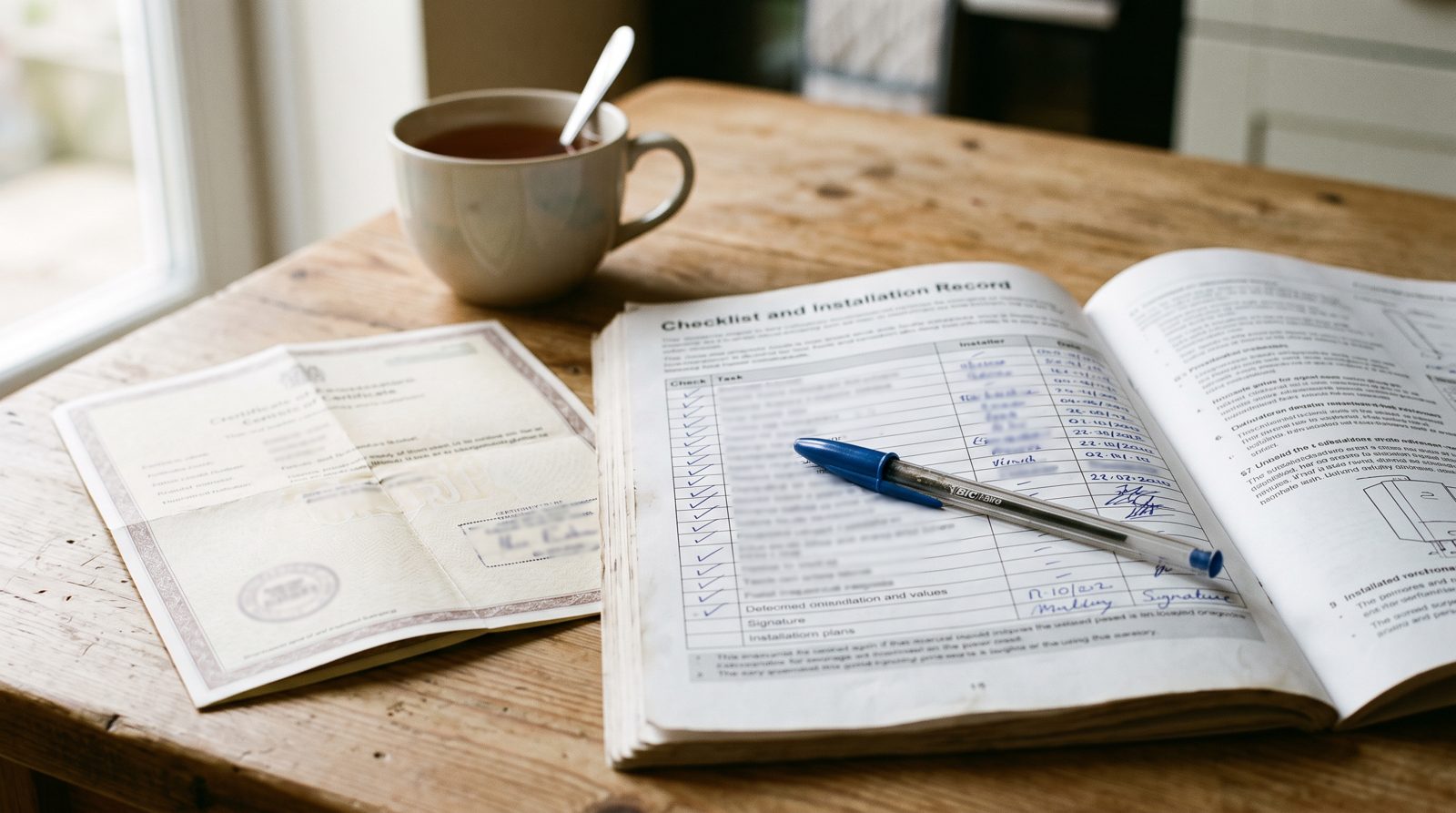
Benchmark is the industry scheme that records how a boiler was commissioned. The checklist lives inside the back of the boiler’s installation manual and the engineer fills it in on the day: the gas or oil pressure, the combustion readings from the flue gas analyser, the system cleaning and inhibitor, the controls fitted and the engineer’s registration number. Manufacturers use it as the basis of the warranty, so if the checklist is blank, the warranty may not be honoured.
2. The Building Regulations Compliance Certificate
This is the boiler installation certificate most people mean. A registered installer notifies the local authority of the installation through their competent person scheme, and the scheme issues the certificate to the homeowner. Gas Safe sends it for gas boilers, OFTEC for oil. It confirms the work met the Building Regulations for flues, ventilation, efficiency and fuel supply, and it is recorded against your address on the local authority’s register.
3. The warranty registration
The installer registers the boiler with the manufacturer, usually online, within 30 days of installation. You should receive a confirmation, and the warranty is only valid if the boiler is serviced annually by a registered engineer. Keep the confirmation with the manual.
Why the certificate matters
- Selling your home. Conveyancing solicitors ask for the compliance certificate for any boiler installed since 2005. Without it, the buyer may ask for a retrospective inspection or an indemnity policy.
- Warranty claims. Manufacturers can ask for the Benchmark record and proof of annual servicing before authorising a repair under warranty.
- Insurance. Some home insurers ask whether the boiler was professionally installed and certified after a claim involving fire, gas or water.
- Letting a property. Landlords need to show gas appliances were installed by a registered engineer alongside the annual gas safety record.
Where to find your boiler installation certificate
Start with the obvious places: the boiler manual, the folder of house documents you were given when you bought, or the installer’s paperwork. If you had the boiler fitted yourself, check your email for a message from Gas Safe, OFTEC or the manufacturer around the installation date. If you bought the house with the boiler already installed, the certificate should have been in the seller’s pack.
If it is nowhere to be found, there are three ways to trace it:
- Ask the installer. The company that fitted the boiler can look up the notification and request a copy.
- Ask Gas Safe or OFTEC. Both can issue a replacement certificate for a small fee if the installation was notified. You will need the address and a rough installation date.
- Ask the council. Building control departments hold a record of notified installations. If the boiler was fitted under a building notice rather than a competent person scheme, the council is the only place the record exists.
What if the installation was never notified?
It happens more than it should. A boiler fitted by an unregistered installer, or by a registered one who never got round to the paperwork, has no certificate to find. The options are a regularisation certificate from the council, which involves an inspection and a fee, or an indemnity insurance policy if you are selling. Neither is ideal. A registered engineer can also inspect the installation and issue a gas safety record confirming it is safe, which reassures a buyer even if it does not replace the compliance certificate. That check can be combined with your annual boiler servicing visit.

How to check a certificate is genuine
A real compliance certificate carries the scheme’s name, a unique certificate number, the property address, the appliance details and the installer’s registration number. You can verify a Gas Safe engineer’s number on the Gas Safe Register website, and the Register also lets you check whether work at your address has been notified. If someone hands you a “certificate” that is really just an invoice with the word certificate typed on it, it is not the same thing.
How DCI Boilers can help
Every boiler DCI Boilers installs across Cornwall and Devon is notified through Gas Safe or OFTEC, commissioned with a completed Benchmark checklist and registered for its manufacturer warranty, so you get all three documents without asking. If you have inherited a boiler with missing paperwork, we can inspect it, issue a safety record and advise on the certificate. And if the boiler turns out to be past its best, our gas boiler replacement service starts with a free survey.
Need help now? Call DCI Boilers on 07888 862 603 or get a free quote.
Frequently asked questions
What does a boiler installation certificate look like?
It is a single-page document from Gas Safe or OFTEC headed Building Regulations Compliance Certificate, with a certificate number, your address, the appliance details and the installer’s registration number.
How long after installation does the certificate arrive?
Usually within a few weeks. Installers have a limited time to notify the work, and the scheme then posts or emails the certificate to the property.
Can I get a boiler installation certificate online?
Gas Safe and OFTEC both let you request a replacement online if the installation was notified. You will need the address and approximate date.
Do I need a certificate for a boiler installed before 2005?
Notification became compulsory for gas boilers in April 2005 and for oil boilers a little later, so older installations will not have one. A current gas safety check is the usual substitute when selling.