
No hot water from a combi boiler usually comes down to one of a handful of causes: no power reaching the boiler, low system pressure, a controls or timer mix-up, a frozen condensate pipe in cold weather, or a worn internal part, most commonly the diverter valve. The best approach is to work through the quick checks in order before assuming the worst, because a surprising number of “broken” boilers are fixed in five minutes without an engineer.
A combi heats water on demand rather than storing it, so when the hot tap runs cold the problem sits either with the boiler being unable to fire at all, or with it firing but failing to send the heat to your taps. Which of those two it is tells you a lot, and we will show you how to spot the difference below.
Work through these checks in order. If you get to the end without hot water, it is time for boiler repairs from a Gas Safe registered engineer, and nothing on this list will have been wasted, because you will be able to tell the engineer exactly what you found.
1. Check the power and the gas
Start with the obvious, because it catches more people than you would think.
- Is the display lit? A dead display means no power. Check the fused spur switch next to the boiler, then your consumer unit for a tripped breaker.
- Has a prepayment meter run out? No credit means no gas, and the boiler will fail quietly.
- Are other gas appliances working? If the hob will not light either, the issue is your gas supply, not the boiler. Check whether your emergency control valve has been knocked closed, and contact your gas supplier if the supply is off.
2. Check the pressure gauge
Combi boilers need system pressure of roughly 1 to 1.5 bar when cold. Below 1 bar, most models lock out and stop heating water altogether, usually with a fault code on the display. If the needle is low, top the system up using the filling loop underneath the boiler. Our step-by-step guide to repressurising a boiler walks you through it, and it takes about five minutes with no tools. If the pressure keeps dropping after you top up, there is a leak or an internal fault, which is a job for an engineer.
3. Check the controls, clock and thermostat
Controls cause more phantom breakdowns than any mechanical part.
- Hot water mode. Make sure the boiler is set to heat water, not heating only. On many models this is a dial or button showing a tap symbol.
- The clock. After a power cut, timers can reset and decide it is 3am. Check the time and the programme.
- The temperature setting. If someone has nudged the hot water temperature right down, water may arrive lukewarm rather than hot.
- Smart controls. If you use a smart thermostat or app, check it is online and has not dropped its connection to the boiler.
Also worth a thought: is it just one tap? If the kitchen runs hot but the bathroom does not, the fault is in the tap or its pipework, not the boiler.
4. In cold weather, check the condensate pipe
If the failure arrived with a cold snap, the prime suspect is a frozen condensate pipe. This is the plastic pipe that carries slightly acidic waste water from the boiler to a drain, and where it runs outside it can freeze solid, causing the boiler to shut down. The giveaway is a gurgling sound and a fault code during freezing weather. Thawing it is straightforward: pour warm (never boiling) water along the frozen section, or hold a hot water bottle against it, then reset the boiler. Our full guide to a frozen condensate pipe covers thawing and lagging in detail.
5. Still nothing? It may be the diverter valve
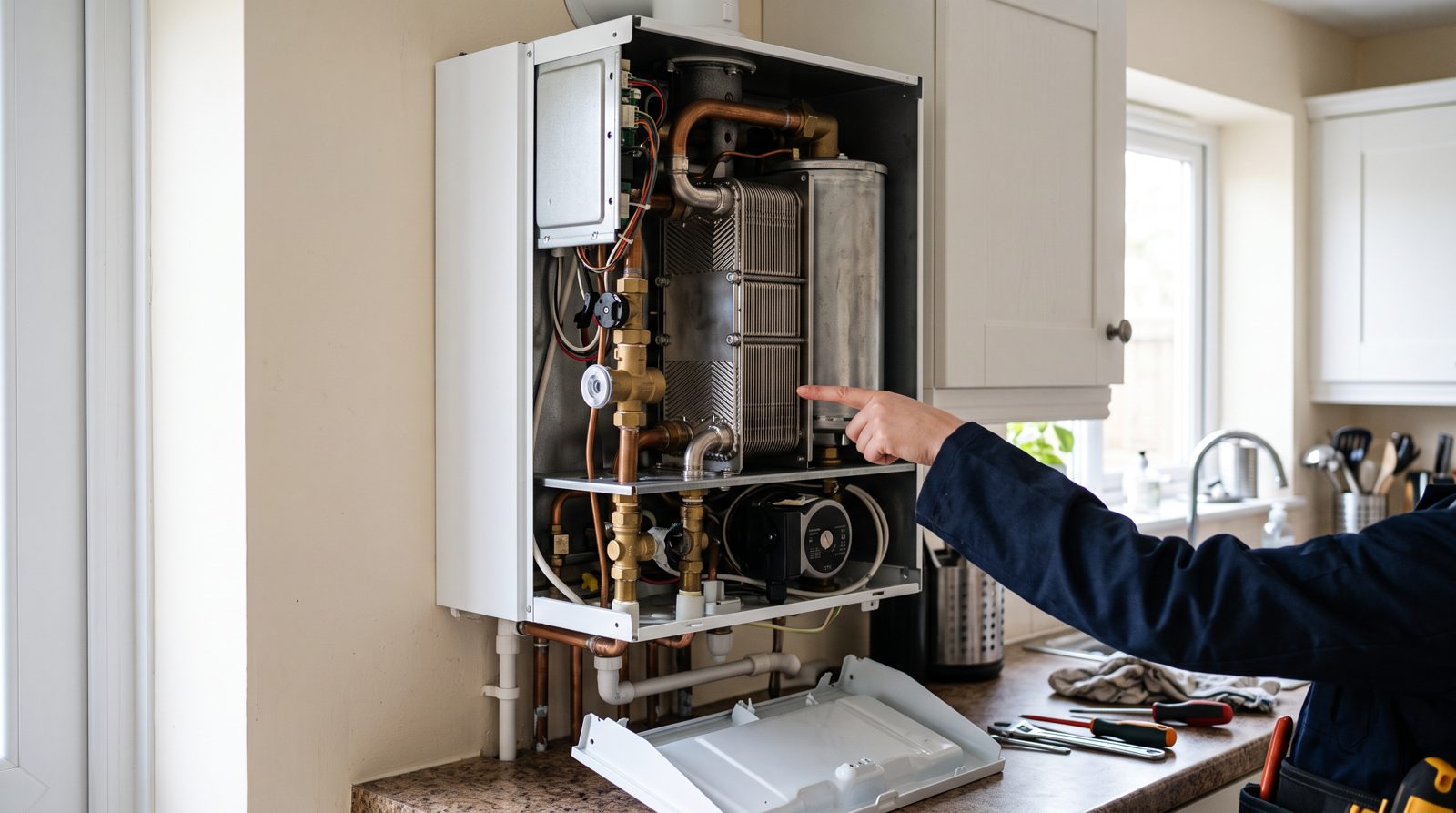
Here is the classic combi fault. Inside every combi is a diverter valve, a motorised gate that switches the boiler’s heat between the radiators and the hot water circuit. When it wears or sticks, you get the tell-tale combination: central heating works fine, but the taps run cold or lukewarm, or occasionally the reverse. Sometimes you only get hot water while the heating is also running.
A sticking diverter valve is a very common failure on boilers past their fifth birthday, and it will not fix itself. Replacing the valve or its diaphragm means opening the boiler, which is strictly a job for a Gas Safe registered engineer. Never remove the casing or attempt to free a valve yourself, however handy you are. Gas work is illegal without registration, and for good reason.
Other internal culprits an engineer will check include a scaled-up plate heat exchanger (common in hard water areas), a faulty flow sensor that fails to notice you have opened a tap, and a failing pump.
When to treat it as an emergency
No hot water with a working heating system is miserable but usually safe to wait a day for. Treat it as urgent if the boiler is leaking water, making banging or whistling noises, tripping the electrics, or if you have vulnerable people in the house with no hot water or heating at all in winter. DCI Boilers runs a 24/7 emergency boiler call-out service across Cornwall and Devon for exactly these situations.
And if you can smell gas at any point, stop. Do not operate switches, open the windows and doors, leave the property and call the National Gas Emergency line on 0800 111 999 immediately.
How DCI Boilers can help
If the checks above have not brought your hot water back, DCI Boilers will. Our Gas Safe and OFTEC registered engineers carry out boiler repairs across Cornwall and Devon, from diverter valves to heat exchangers, with fixed upfront pricing so you know the cost before we lift a screwdriver. If a fault keeps coming back on an older boiler, we will give you an honest view on repair versus a gas boiler replacement with up to 12 year manufacturer warranties.
Need help now? Call DCI Boilers on 07888 862 603 or get a free quote.
Frequently asked questions
Why does my combi boiler heat the radiators but not the water?
That combination points strongly to a faulty diverter valve, the internal component that switches heat between the radiators and the hot water circuit. It is a common wear item on older combis and needs a Gas Safe engineer to replace.
Why do I only get lukewarm water from my combi boiler?
Common causes include a partially stuck diverter valve, a scaled-up plate heat exchanger, or simply the hot water temperature being set too low on the boiler. Check the setting first, then book an engineer if it does not improve.
How much does it cost to fix no hot water on a combi boiler?
It depends on the fault. As a rough guide, most single-component combi repairs land somewhere between £150 and £450 including parts, but the honest answer is a fixed quote once the fault is diagnosed, which we provide free before any work begins.
Is no hot water an emergency?
Usually not on its own, but it becomes one if the boiler is leaking, making unusual noises, or the house has vulnerable occupants with no heating in winter. In those cases use our 24/7 emergency line rather than waiting for a routine appointment.