

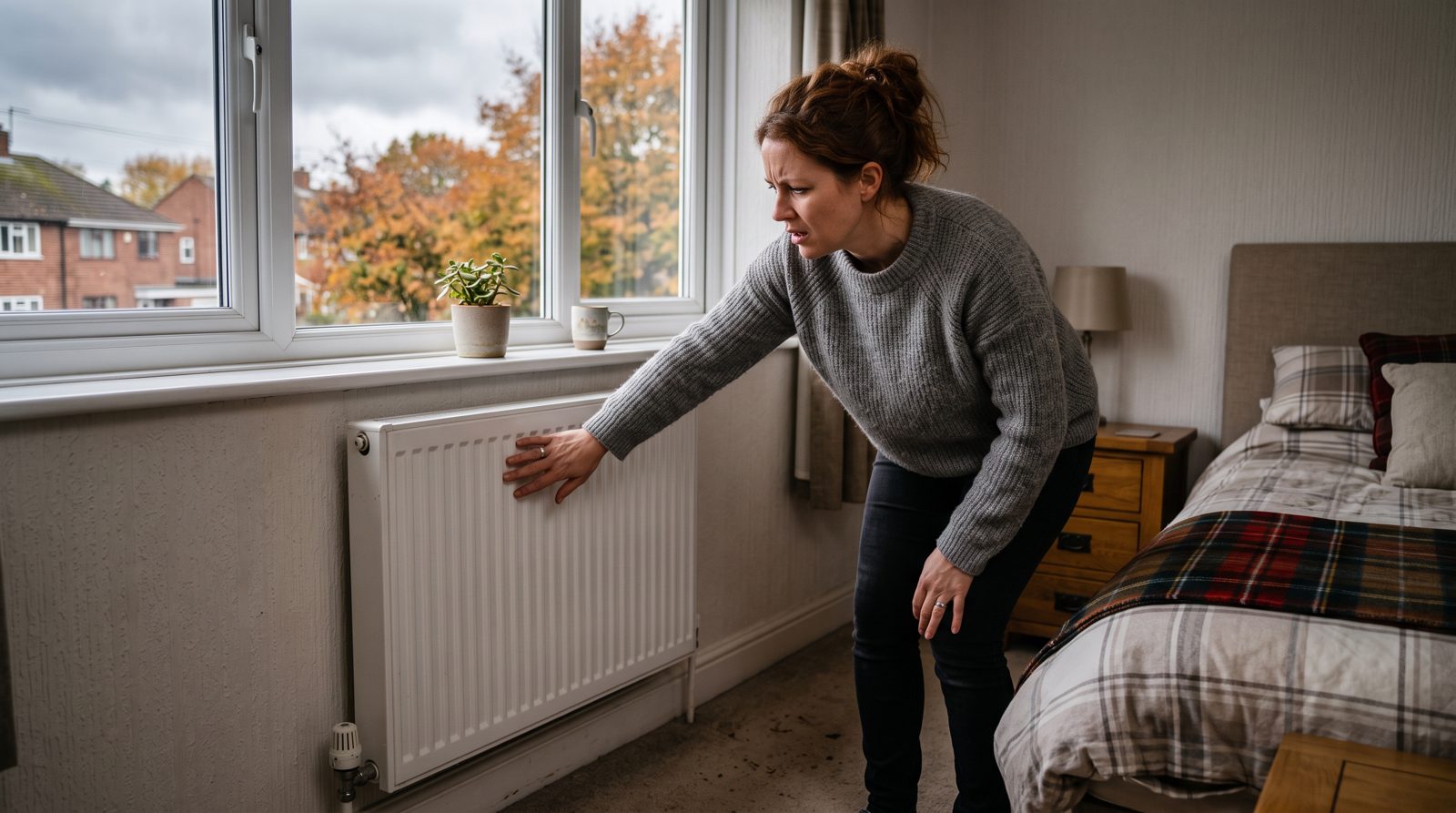
Central heating that will not work after summer is one of the most common calls a heating engineer gets in September and October. The boiler has spent months doing nothing but hot water, and the parts that only move when the heating runs, such as the pump, the diverter valve and the motorised valves, can stick after a long rest. Add a thermostat with flat batteries or a programmer still on its summer setting, and it is easy to see why the radiators stay cold.
The good news is that a fair share of these problems are simple. This guide lists the causes in order of how often they turn up, starting with the ones you can check yourself in five minutes, and finishing with the faults that need a Gas Safe or OFTEC registered engineer.
Start with the controls
Before you assume the boiler is broken, check the things that tell it to come on.
- Thermostat batteries. A wireless room thermostat with flat batteries simply stops talking to the boiler. Replace them and wait a minute for it to reconnect.
- Thermostat setting. Turn the thermostat up well above the room temperature. If it is set to 18 and the hallway is already 19, the heating will not fire.
- Programmer or timer. Many households switch the heating to off or to hot water only in spring. Check the programmer is set to heating and hot water, and that the current time is inside a heating period. If the clocks changed and the programmer did not, the schedule may be an hour out.
- Smart thermostats. Check the app for a holiday mode or a schedule that still thinks it is July. A smart thermostat that has dropped off the Wi-Fi may also need reconnecting.

Check the boiler itself
If the controls are calling for heat and the boiler still does nothing, look at the boiler.
- Pressure. Sealed systems slowly lose a little pressure over the summer. If the gauge reads below 1 bar the boiler will refuse to run the heating. Top it up to around 1.3 bar using the filling loop. Our guide on how to repressurise a boiler walks through it.
- Fault codes. A code on the display is a clue, not a sentence. Look it up in the manual before you reset. Repeated resets of a boiler that keeps locking out can make a fault worse.
- Power. Check the fused spur next to the boiler has not been switched off during summer decorating, and that the fuse has not blown.
- Oil supply. On an oil boiler, check the tank gauge. A tank that ran low in spring may have let air into the fuel line, which causes the burner to lock out. Our guide to an oil boiler not working covers the reset and the checks.
Hot water works but heating does not
This is the classic autumn fault and it tells you the boiler itself is fine. The problem is in the parts that switch between hot water and heating.
- Diverter valve (combi boilers). The valve that sends hot water to the taps or to the radiators can stick in the hot water position after months of never moving. Sometimes a few cycles of the heating frees it. Often it needs an engineer to free or replace it.
- Motorised valves (system and conventional boilers). The two-port or three-port valves that direct water to the radiators or the cylinder can seize, or their small motors can fail. A valve that is hot on one side and cold on the other is a giveaway.
- Pump. A circulating pump that has sat still all summer can stick. A gentle tap on the casing sometimes gets it going, but a pump that needs tapping is a pump that is on its way out.
We have a fuller guide to heating not working but hot water is if this matches your symptoms.
Radiators are warm but not hot, or only some are working
If the boiler fires and some radiators heat but others stay cold, the boiler is doing its job and the problem is in the system.
- Air in the radiators. Bleed each radiator from the top of the house down. Recheck the boiler pressure afterwards.
- Stuck radiator valves. Thermostatic valves that were turned down in spring can stick closed. Remove the head and gently press the pin with a spanner to free it.
- Sludge. Radiators that are cold at the bottom and warm at the top have sludge settled inside. That is a job for a chemical clean or a power flush rather than a bleed.
When to call an engineer
Call a registered engineer if the boiler shows a fault code that comes straight back after a reset, if you can smell gas or oil, if the pressure will not hold, if the pump or a valve is clearly seized, or if you have been through the checks above and the radiators are still cold. Diverter valves, motorised valves, pumps and printed circuit boards are all common autumn repairs and all of them are cheaper to fix in September than in the first cold week of December when every engineer’s diary is full.
Avoiding the same problem next year
Two habits prevent most autumn failures. Run the heating for ten minutes once a month through the summer, which keeps the valves and pump moving. And book an annual boiler servicing visit in late summer, so any sticking part is found and freed before you actually need the heating.
How DCI Boilers can help
DCI Boilers provides boiler repairs across Cornwall and Devon for gas and oil systems, with Gas Safe and OFTEC registered engineers and fixed pricing agreed before we start. If you have no heating and the house is getting cold, our emergency boiler call-out service runs around the clock.
Need help now? Call DCI Boilers on 07888 862 603 or get a free quote.
Frequently asked questions
Why does my heating not work after summer when the hot water is fine?
The parts that only move when the heating runs, such as the diverter valve, motorised valves and pump, can stick after months of standing still. The boiler is fine; the switching is not.
Should I run my heating in summer?
Ten minutes once a month is enough to keep the valves and pump moving and avoid a seized part in autumn.
Can I fix a stuck diverter valve myself?
Cycling the heating on and off a few times occasionally frees it, but the valve itself sits inside the boiler and replacing it is a job for a registered engineer.
Is it worth getting the boiler serviced before winter?
Yes. A late summer service finds sticking parts, low pressure and worn components before the cold weather, when repairs are slower to book.