
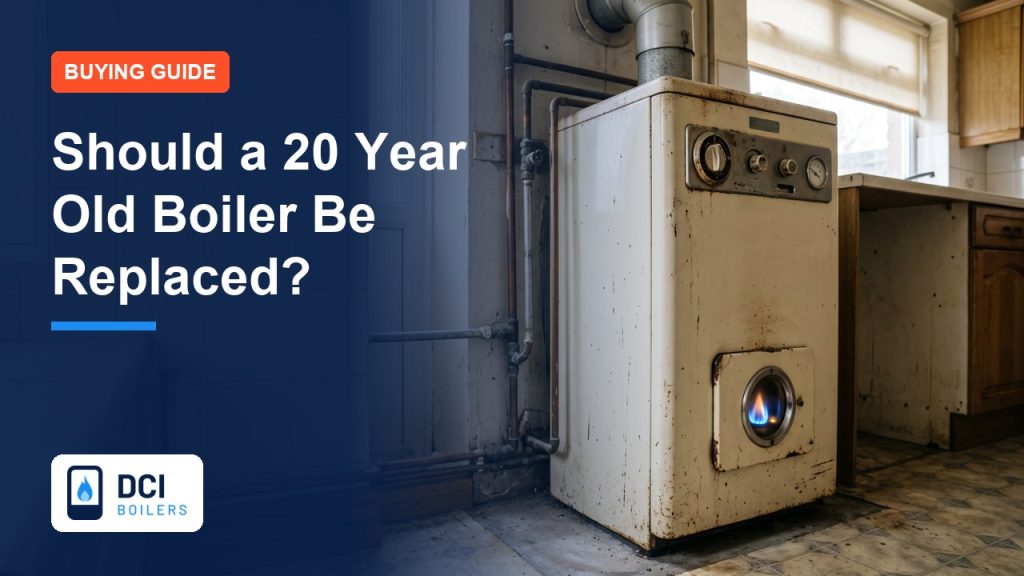
In most cases a 20 year old boiler should be replaced, or at least planned for replacement, because it is almost certainly a non-condensing model that wastes a large share of the fuel it burns, parts are becoming hard to find, and each winter increases the chance of a breakdown when engineers are busiest. The exception is a boiler that has been serviced every year, still passes its safety checks and has needed nothing more than routine parts. That boiler can carry on a little longer, but it is living on borrowed time.
This is not a sales pitch. Plenty of twenty year old boilers are still going, and some will outlast their replacements. The question is whether keeping yours is a sound decision or simply the path of least resistance. Here are the factors that actually decide it.
What twenty years does to a boiler
Efficiency
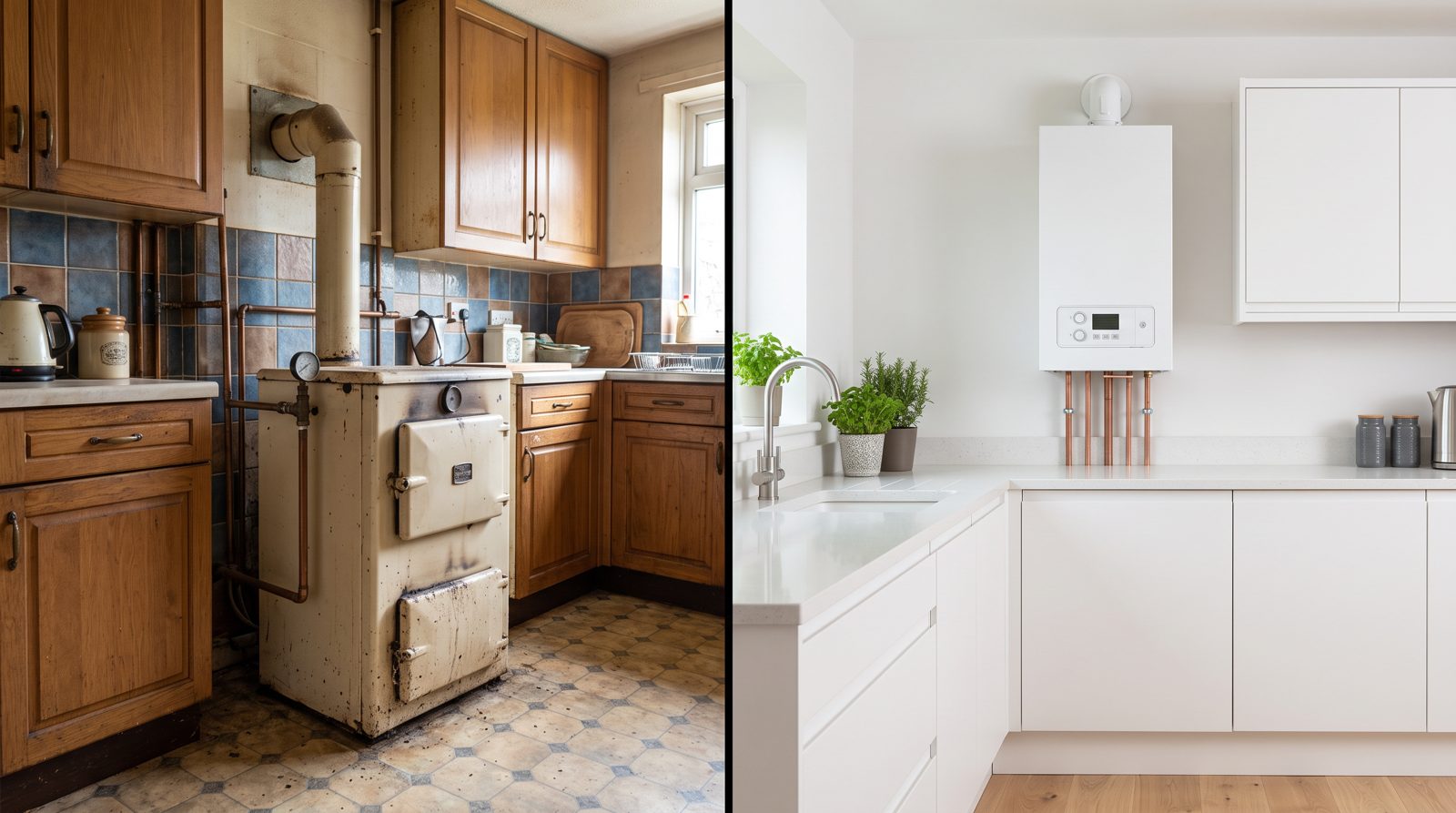
Boilers fitted before 2005 were mostly non-condensing, and their efficiency when new was typically in the region of 60 to 80 per cent. After twenty years of use it will have dropped further. A modern condensing boiler runs at over 90 per cent. The difference is not a marginal saving; it is a large share of every heating bill going up the flue. Our guide to the most efficient combi boilers explains how efficiency is rated.
Reliability
Fans, pumps, printed circuit boards, gas valves and heat exchangers all have a working life. On a twenty year old boiler several of them are at or past it. Repairs become more frequent and each one is a gamble on how long the next part lasts.
Parts
Manufacturers typically support a model for ten years after production ends. At twenty years, common parts may still be available from specialists, but a heat exchanger or a control board can be impossible to source, at which point a single fault ends the boiler’s life.
Safety
An old boiler that is serviced annually is not inherently unsafe. But older open-flued designs rely on room ventilation and a sound chimney, seals degrade, and a heat exchanger crack can leak combustion gases. A registered engineer will condemn a boiler that fails a safety check, sometimes with little warning.
Signs it is time
- it has needed repairs in two of the last three winters
- the flame burns yellow or orange rather than blue
- it takes longer to heat the house than it used to
- the engineer has mentioned parts being hard to get
- it is noisier, or it smells when running
- your bills have crept up without a change in tariff
- it has a permanent pilot light
Our guide on the signs you need a new boiler goes through each of these in detail.
When a repair still makes sense
If the fault is minor and the part is available, and the boiler has otherwise been reliable, a repair can buy another winter or two while you plan the replacement on your own terms. That is a perfectly reasonable choice, particularly if you are thinking of changing the type of system, moving the boiler or renovating the kitchen and would rather do it all at once. What you should avoid is spending a significant sum on a major component of a boiler that is likely to need another one soon.
How to decide
Ask a registered engineer for an honest assessment at the next service: the condition of the heat exchanger, the combustion readings, the parts that are wearing and the availability of spares. Then weigh three things:
- The likely cost of repairs over the next two years against the cost of a new boiler with a long warranty.
- The fuel saving from moving to a condensing boiler, which on a twenty year old model is substantial.
- The risk of a failure in January and a hurried replacement at the worst time of year.
Replacing on your own timetable, in late summer, with a survey and a fixed quote, is almost always cheaper and calmer than replacing in an emergency.

What replacement involves
A twenty year old boiler is often a conventional or system boiler with a cylinder and loft tanks, so replacement is frequently a conversion to a combi or a modern system boiler. That means a two-day job rather than a one-day swap, plus a thorough flush of a system that has two decades of sludge in it. Our guide on whether fitting a new boiler is a big job sets out what to expect.
How DCI Boilers can help
DCI Boilers can assess an old boiler honestly and tell you whether it is worth keeping. When it is time, our Gas Safe and OFTEC registered engineers fit modern condensing boilers across Cornwall and Devon at a fixed price with manufacturer warranties of up to 12 years. Read about our gas boiler replacement and oil boiler replacement services, or book a boiler servicing visit and ask for an assessment.
Need help now? Call DCI Boilers on 07888 862 603 or get a free quote.
Frequently asked questions
How long should a boiler last?
Ten to fifteen years is typical for a modern boiler. Older, simpler boilers sometimes run for twenty or more, at the cost of efficiency.
Is a 20 year old boiler dangerous?
Not if it is serviced annually and passes its safety checks. It should not be run without a service, and it should have a carbon monoxide alarm nearby.
Will a new boiler really save money?
Moving from a non-condensing boiler to a condensing one cuts the fuel used for the same heat noticeably. The exact saving depends on your usage and tariff.
Can I still get parts for a 20 year old boiler?
Some, from specialist suppliers. Major components such as heat exchangers and control boards are often no longer made.