
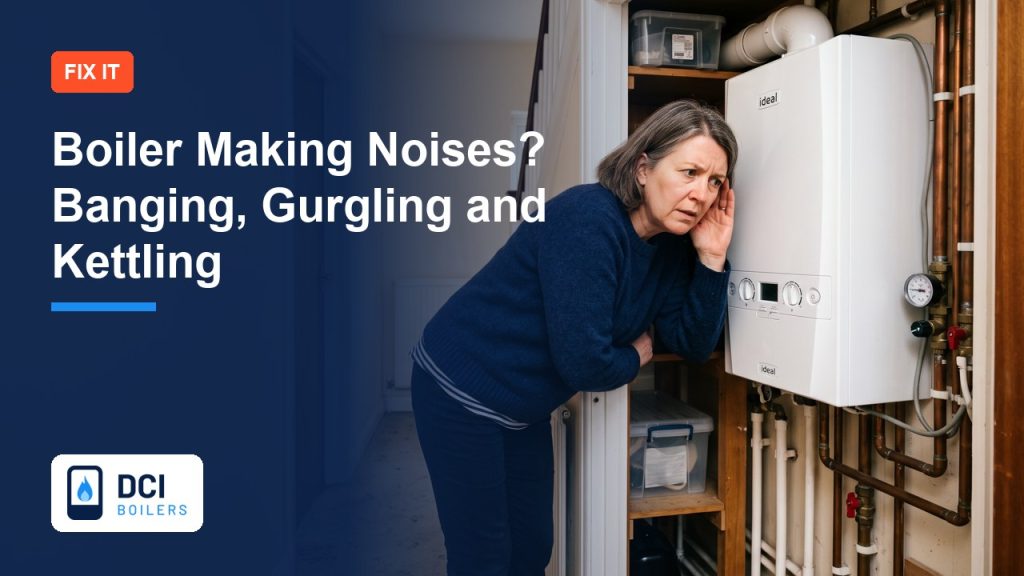
Most boiler noises have a specific cause that an engineer can name from the sound alone. A kettle-like rumble is scale or sludge on the heat exchanger. Gurgling is air in the system or a blocked condensate pipe. Banging on start-up is delayed ignition or trapped air. Whistling is usually a restriction or a fast-flowing pump. Humming and vibration point to the pump or fan. None of these is normal, some are urgent, and almost all get worse if left. This guide takes each sound in turn.
Kettling: a rumble or whistle like a kettle boiling
Kettling is the most common boiler noise and the most telling. Limescale in hard water areas, or sludge in any area, builds up on the heat exchanger. The layer insulates the metal, the water behind it overheats and boils in pockets, and the steam bubbles collapse with a rumble. It sounds like a kettle about to switch off. Kettling makes the boiler less efficient and, over time, cracks the heat exchanger. The fix is a chemical descale or a power flush of the system, a magnetic filter and inhibitor, and in hard water areas a scale reducer on the incoming main. Our guide to radiators cold at the bottom explains the sludge side.
Gurgling or bubbling
Gurgling from the boiler or the pipes near it is air moving through the system. Bleed the radiators, starting at the top of the house, and top the pressure back up. If it returns quickly, air is getting in somewhere, usually through a leak or a faulty automatic air vent. Gurgling from the boiler on a cold morning, with the boiler locking out, is a partly blocked or frozen condensate pipe. Our guide to a frozen condensate pipe covers that one.

Banging or clunking
A bang when the boiler fires is delayed ignition: gas or oil builds up for a moment before it lights and ignites in a rush. It is hard on the boiler and should be looked at promptly, particularly on an oil boiler. A clunk or knock from pipework when the heating comes on or goes off is thermal expansion, pipes moving against joists or clips as they warm, which is a nuisance rather than a danger and is fixed by re-clipping or padding the pipe. A loud bang followed by a lockout is the boiler protecting itself.
Whistling or high-pitched noise
A whistle from the boiler is often kettling in its early stages, or water forced through a restriction such as a partly closed valve or a scaled pipe. A whistle from a radiator valve is the valve nearly closed with fast-flowing water, which balancing fixes. A whistle from the flue or fan is a fan bearing on its way out.
Humming, droning or vibration
A hum that rises and falls with the heating is usually the pump, either running too fast for the system or with worn bearings. Many pumps have a speed setting; dropping it a notch can cure the hum, and an engineer can check. A hum from the boiler itself with the pump quiet can be the fan or a gas valve. Vibration through the wall is often a pump or fan whose mountings have loosened.
Tapping or ticking
A steady tick as the boiler warms up or cools down is expansion in the pipework and casing and is harmless. A rapid tapping with the boiler running can be a loose component or, on a combi, a plate heat exchanger scaling up.
Dripping
A drip inside the boiler, or a drip from the pipe outside, means a leak or a pressure relief valve discharging. Our guide to water dripping from the pipe outside your boiler explains the outside case. Water inside the boiler is an engineer’s job.
Which noises are urgent
- A bang on ignition, especially with a smell of gas or oil: switch off and call.
- Loud kettling with the boiler cutting out on overheat: call soon, before the heat exchanger cracks.
- A screaming fan: the fan will fail and the boiler will lock out.
- Any noise with a leak: call.
Everything else can wait for a normal appointment, but none of it should be ignored, because noise is the boiler telling you a part is under stress.

What the engineer will do
An engineer listens with the casing off to locate the sound, checks the pressure and the condensate route, tests the pump and fan, inspects the heat exchanger for scale and the system water for sludge, and checks ignition and combustion with an analyser. Most noises are cured by a descale or flush, a pump speed change, a new fan or a re-clipped pipe. Our guide to the signs you need a new boiler covers the point at which persistent kettling on an old boiler tips the balance.
How DCI Boilers can help
DCI Boilers diagnoses and fixes noisy boilers across Cornwall and Devon, from descaling and power flushing to pumps, fans and ignition faults, with Gas Safe and OFTEC registered engineers and fixed prices agreed before work starts. Book boiler repairs, or mention the noise at your next boiler servicing visit. A banging boiler with a smell of fuel is an emergency boiler call-out.
Need help now? Call DCI Boilers on 07888 862 603 or get a free quote.
Frequently asked questions
Why does my boiler sound like a kettle?
Scale or sludge on the heat exchanger is making water boil in pockets. A descale or flush and a filter cure it.
Is a noisy boiler dangerous?
Most noises are not dangerous in themselves, but a bang on ignition or a noise with a fuel smell should be treated as urgent.
Why does my boiler bang when it starts?
Delayed ignition: fuel builds up before it lights. It needs an engineer to check the ignition and combustion settings.
Can I stop my boiler humming?
If it is the pump, an engineer can lower the pump speed or replace worn bearings. If it is the fan, the fan usually needs replacing.