
Yes, a boiler can be moved to another room, and it is often done during a replacement to free up a kitchen cupboard or quieten a bedroom wall. Whether a particular spot works depends on four things: whether a flue can terminate there within the rules, whether the gas or oil supply can be extended to it, whether the condensate can drain, and whether the engineer will be able to reach the boiler for servicing. Relocation adds time and pipework to the job, so it is best planned as part of a gas boiler replacement rather than done on its own.
This guide explains what makes a location possible, which rooms are usually good and bad choices, what the extra work involves and what a survey will want to check before anyone commits.
What makes a new position workable
The flue
The flue is the deciding factor more often than anything else. A horizontal flue has to terminate on an outside wall at set distances from windows, doors, air vents, gutters, boundaries and the ground. A vertical flue through the roof avoids most of those but needs a route up through the building. An internal room with no outside wall and no route to the roof is a non-starter. Our guide on boiler flue regulations lists the distances.
The fuel supply
Gas pipework has to be extended from the meter to the new position, sized correctly for the boiler’s demand, and run along a route that can be inspected. Long runs may need a larger pipe. For oil, the fuel line runs from the tank, and a new position that is further from the tank or higher than it may need a different pump arrangement.
The condensate drain
A condensing boiler produces a steady trickle of acidic water that has to reach a drain. An internal drain, such as a sink waste or soil pipe, is best. An external condensate pipe is allowed but has to be insulated and kept short, or it freezes in winter. A garage or loft position often struggles here.
Access
The boiler needs clearance around it to open the casing and reach the components, and the engineer needs to be able to get to it safely. Building Regulations and manufacturers set minimum clearances, and lofts need a fixed ladder, boarding and a light.
Good and bad rooms for a boiler
| Position | Usually | Watch for |
|---|---|---|
| Kitchen | Good | Cupboard clearances, a drain is usually close by |
| Utility room | Very good | Little to watch, often the ideal spot |
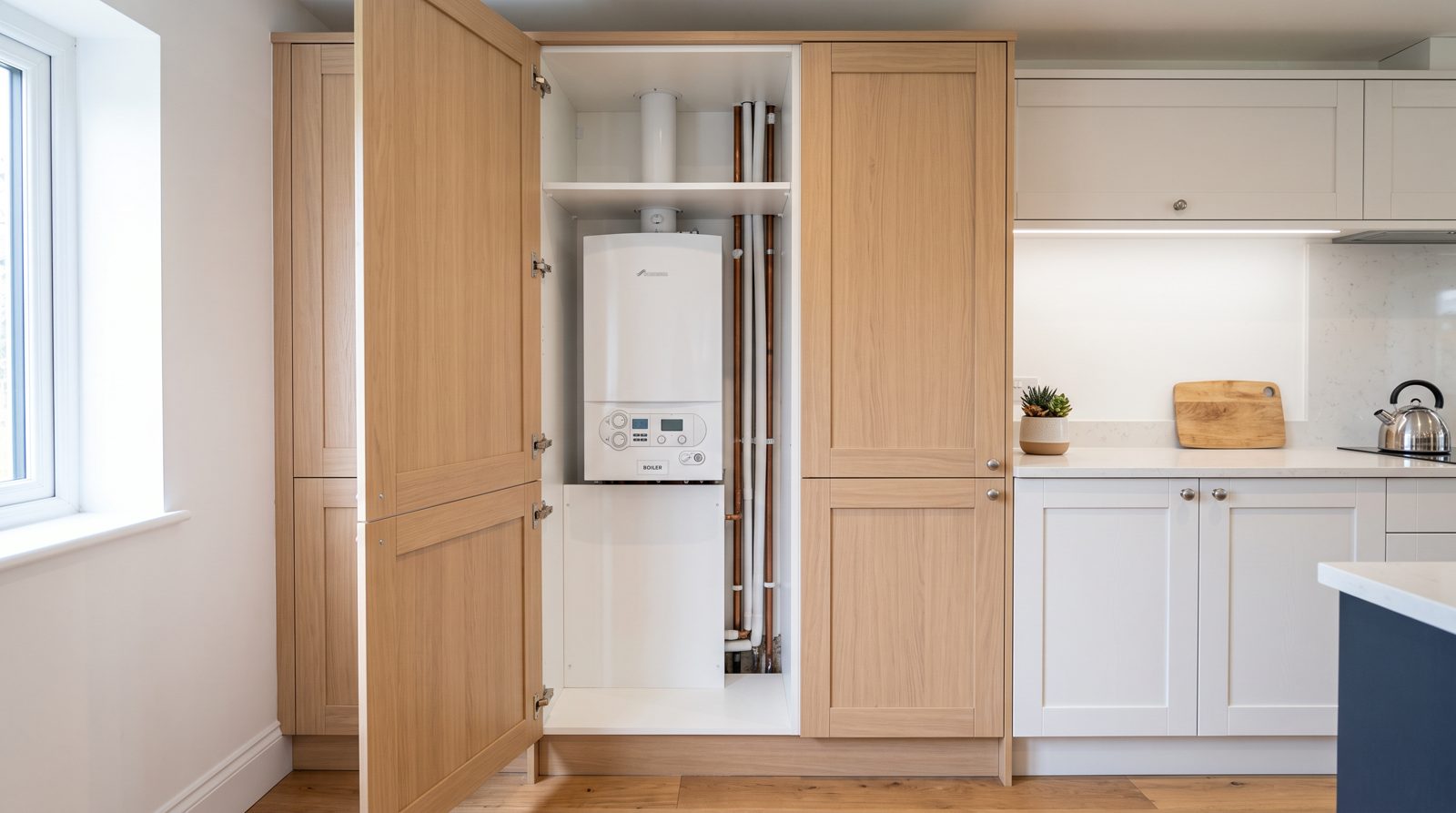
| Airing cupboard | Good | Clearances, ventilation, condensate route |
| Garage | Workable | Frost protection, condensate drain, long pipe runs |
| Loft | Workable | Boarding, fixed ladder, light, frost, condensate, access for servicing |
| Bedroom | Allowed | Noise, and a room-sealed boiler is required |
| Bathroom | Allowed with care | Electrical zones, must be room-sealed, cupboard usually needed |
| Internal room, no outside wall | Rarely | Only if a vertical flue route exists |
Our guide on where a boiler can be installed goes room by room.
What the extra work involves
- running new gas or oil pipework, often under floors or through walls
- a new flue through a different wall or the roof, and making good the old opening
- a new condensate route, sometimes with a small pump if no drain is nearby
- a new electrical spur to the boiler position
- re-routing the heating flow and return and, on a combi, the hot and cold water
- capping off the old pipework and making good where it came out
A relocation typically adds a day to a straightforward replacement, sometimes more if floors have to come up. The survey should state a realistic number of days and a fixed price.
Is it worth it?
Moving a boiler makes sense when it frees space you genuinely want, when the current position is noisy or awkward to service, when a conversion from a cylinder system means the old spot no longer suits a combi, or when the current flue no longer meets the rules. It rarely makes sense as a stand-alone job on a boiler that is not being replaced, because you pay for the labour without gaining a new boiler.
How DCI Boilers can help
DCI Boilers relocates boilers as part of installations across Cornwall and Devon. Our Gas Safe and OFTEC registered engineers survey the proposed position, confirm the flue, fuel, drain and access before quoting, and give you a fixed price for the whole job. Read about our gas boiler replacement service, or if you are moving an oil boiler outside, our oil boiler replacement page covers external units.
Need help now? Call DCI Boilers on 07888 862 603 or get a free quote.
Frequently asked questions
Can a boiler be moved to a loft?
Yes, if the loft has a fixed ladder, boarding, a light, frost protection and a condensate drain route. The survey checks all of these.
Can a combi boiler go in a bedroom?
Modern room-sealed boilers are permitted in bedrooms. Noise is the main drawback, so a cupboard position or another room is usually preferred.
How much longer does a relocation take?
Usually about a day on top of the replacement itself, depending on the pipework route.
Do I need planning permission to move a boiler?
No, but the work must comply with Building Regulations and the installer notifies it through Gas Safe or OFTEC. Listed buildings and flats may have extra rules on flue positions.