
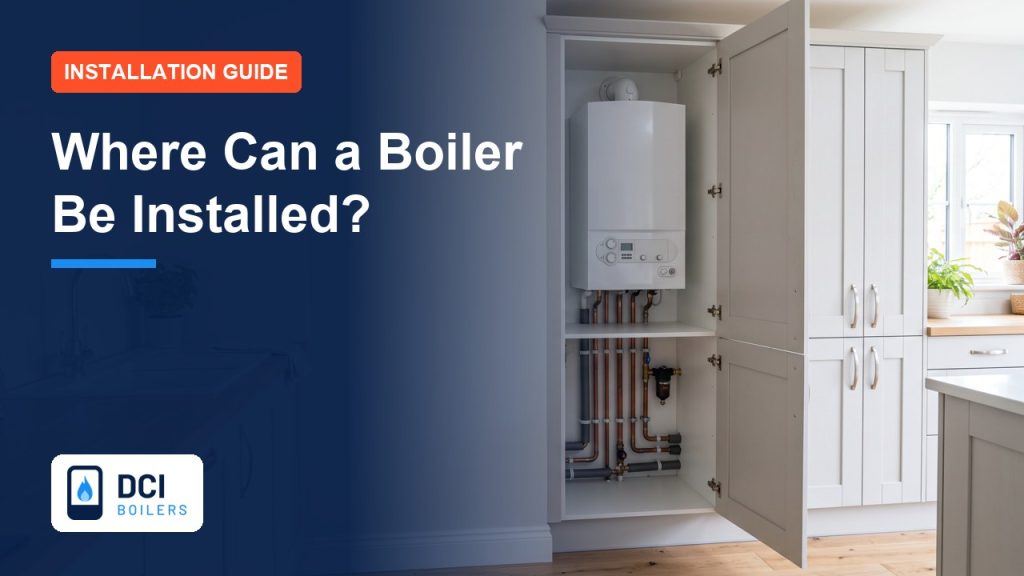
A boiler can be installed in almost any room of a house provided a flue can reach outside within the regulations, the fuel supply and a condensate drain can reach it, there is enough clearance to service it and, in lofts, there is safe access. Kitchens, utility rooms and airing cupboards are the most common and the easiest. Garages and lofts are workable with some extra provisions. Bedrooms and bathrooms are allowed with a room-sealed boiler and a few conditions.
Where the boiler goes affects noise, convenience, servicing and, in a cold spot, the risk of frozen pipes. This guide goes room by room through what the regulations and manufacturers allow, and what experience says works well.
What every position needs
- A flue route. Horizontal through an outside wall, or vertical through the roof, with the terminal at the required distances from openings and boundaries. See our guide on boiler flue regulations.
- Fuel. A correctly sized gas pipe from the meter, or an oil line from the tank.
- A condensate drain. Preferably internal. External runs must be short and insulated.
- Clearances. The manufacturer specifies gaps above, below, in front and to the sides for servicing.
- Electricity. A fused spur.
- Ventilation. Modern room-sealed boilers take their air from outside through the flue, so they do not need a vent in the room, but a compartment still needs the specified clearances.
Kitchen
The classic position and usually the best. The flue goes straight through the outside wall, the sink waste takes the condensate, and the gas is already nearby for the hob. A boiler in a wall cupboard is fine as long as the cupboard gives the clearances the manufacturer lists, and the doors can be opened fully for servicing. Noise is rarely an issue on a modern boiler.
Utility room
If you have one, it is the ideal spot. Space to work, a drain, an outside wall and no one sleeping next to it. Many relocations move the boiler here from a kitchen to free up cupboard space.
Airing cupboard
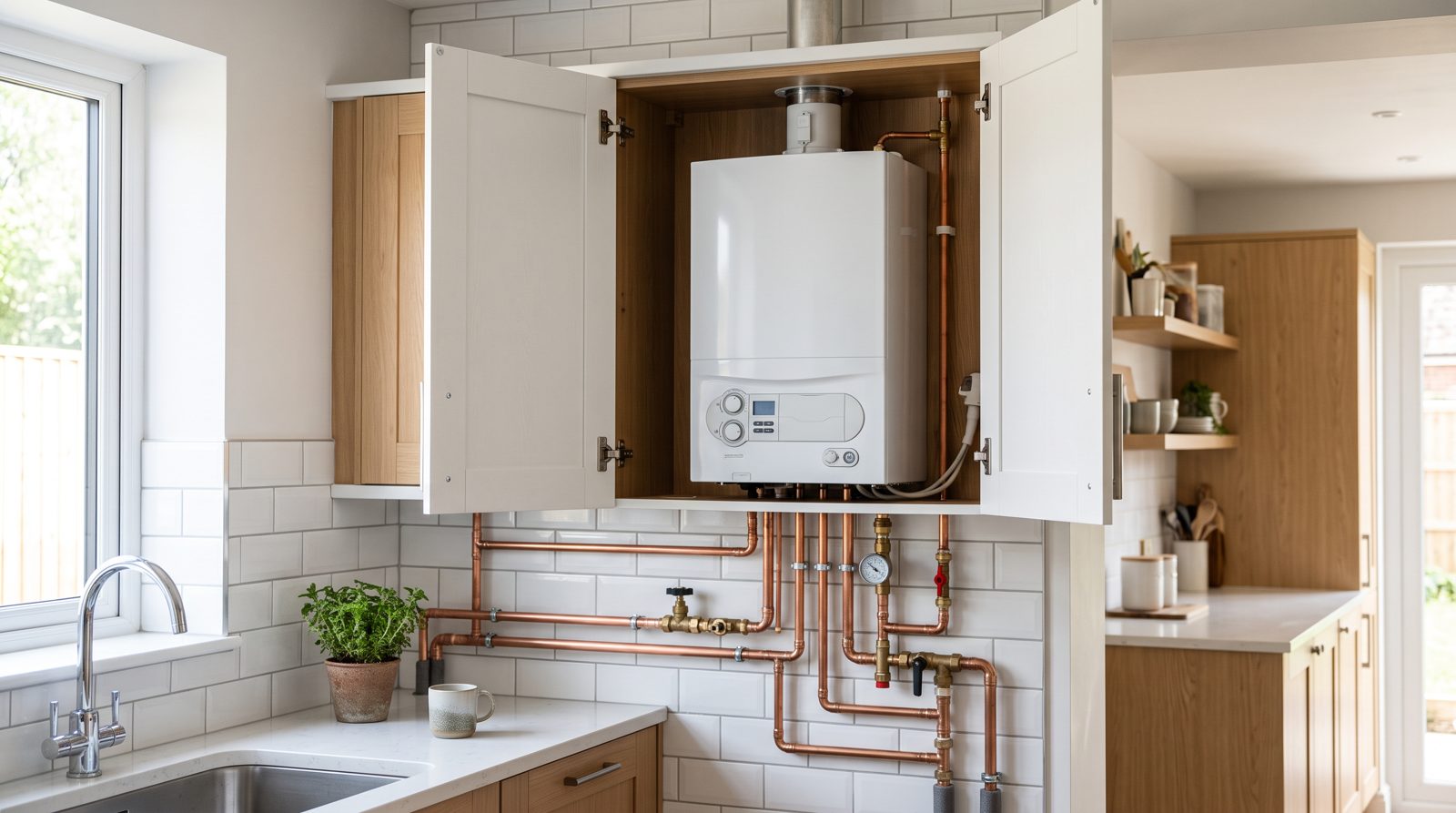
Common in homes converting from a cylinder to a combi, because the cupboard is empty once the cylinder goes. The challenges are the flue route, which may need to go vertically through the roof if there is no outside wall, and the condensate, which needs a drain nearby. Clearances inside a cupboard are non-negotiable.
Garage
Allowed and often convenient, but it is a cold space. The boiler needs frost protection, which most have built in as long as the power stays on, and the condensate pipe must not run outside or through an unheated space without insulation. Long pipe runs from the garage to the house lose heat and need lagging. An attached garage with an internal door is far better than a detached one.
Loft
Permitted, and popular where space downstairs is tight. The conditions are strict: a fixed loft ladder, boarding from the hatch to the boiler and around it, a permanent light, guarding around the hatch, frost protection and a condensate drain route. Servicing is harder and heavier boilers are awkward to lift up. Water pressure at the loft is also lower, which matters for a combi. Manufacturers and Gas Safe engineers will refuse a loft without proper access.
Bedroom
Room-sealed boilers, which is all modern boilers, can be installed in a bedroom. Older open-flued boilers cannot. The practical issue is noise: even a quiet boiler firing at six in the morning is audible. A cupboard within the bedroom, or the landing outside, is usually preferred.
Bathroom
Allowed, again with a room-sealed boiler, but the electrical zoning rules around baths and showers restrict where it can go, and it must be out of reach of anyone using the bath or shower. In practice a boiler in a bathroom lives in a cupboard well away from the water.
Outside
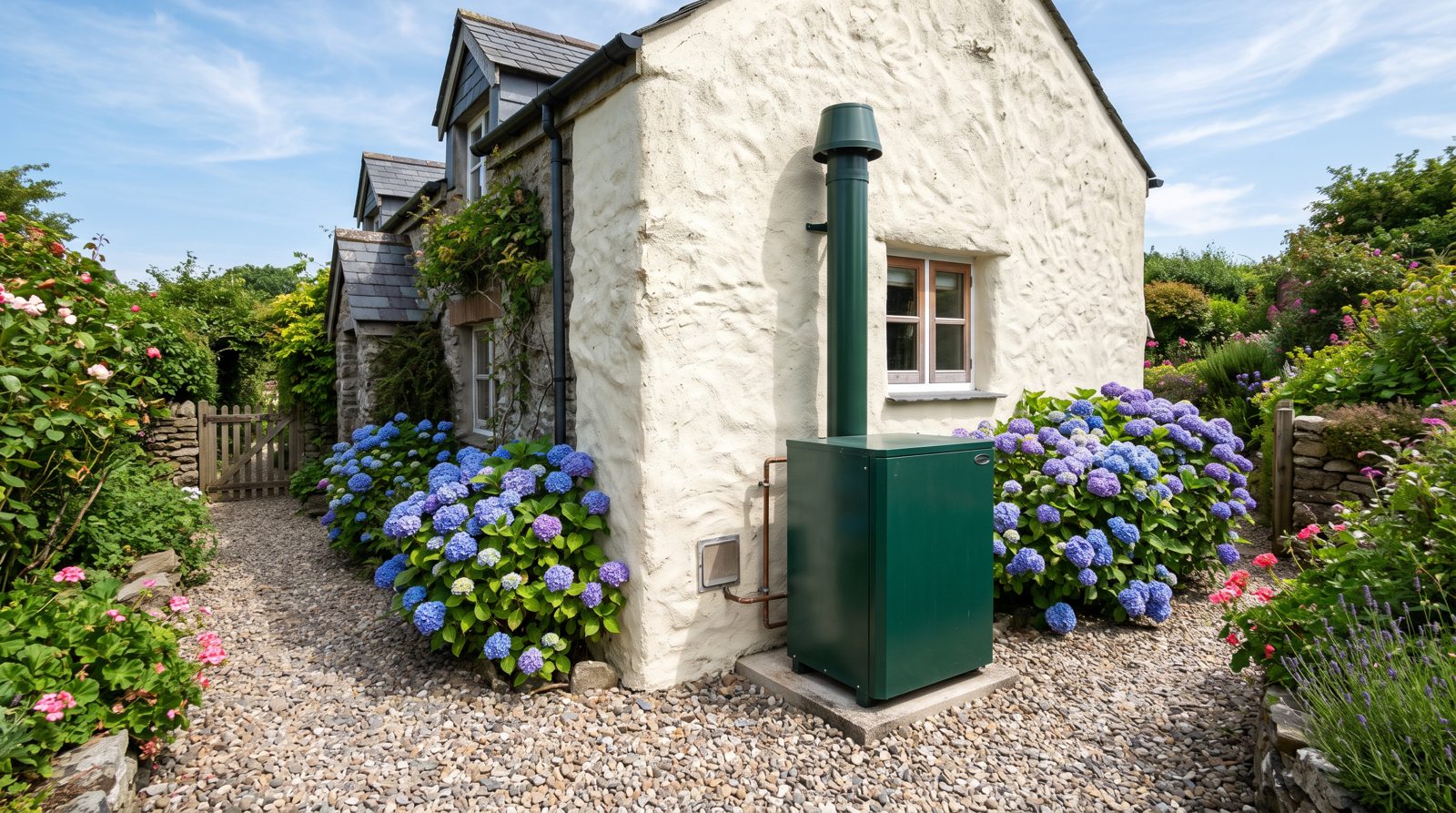
External boilers are common for oil, where the boiler sits against an outside wall in a weatherproof casing, and exist for gas too. They free indoor space entirely and remove the flue question. They need frost protection, a firm base and a sensible position for servicing. Our guide to external oil boilers covers the pros and cons.
Positions that cause trouble
- an internal room with no outside wall and no route to the roof
- a loft without a fixed ladder or boarding
- anywhere the condensate has to run a long way outside
- a tight cupboard with no service clearance
- directly below a window or next to a door where the flue distances cannot be met
- a bedroom wall shared with a light sleeper
How DCI Boilers can help
DCI Boilers surveys every installation across Cornwall and Devon and tells you honestly which positions work in your home and which to avoid. Our Gas Safe and OFTEC registered engineers handle the flue, fuel, drain and access as part of a fixed-price job. See our gas boiler replacement page, or if you are thinking of moving the boiler, our guide on whether you can move a boiler to another room.
Need help now? Call DCI Boilers on 07888 862 603 or get a free quote.
Frequently asked questions
Can a boiler be installed in a bedroom?
Yes, if it is room-sealed, which all modern boilers are. Noise is the main drawback.
Can a boiler go in a loft?
Yes, with a fixed ladder, boarding, lighting, hatch guarding, frost protection and a condensate drain. Without those an engineer will refuse it.
Does a boiler need to be on an outside wall?
No, but the flue must reach outside. An internal wall works if a vertical flue through the roof or a longer horizontal run is possible.
Can a boiler be installed in a cupboard under the stairs?
Occasionally, if the flue can reach an outside wall and the cupboard gives the required clearances, but it is rarely the easiest option.