
The quickest way to check when a boiler was installed is to look for the service sticker on the casing, then the Benchmark checklist inside the manual, then the serial number on the data plate, which manufacturers can decode into a production date. If none of those exist, the Gas Safe Register or your local council may hold a record of the installation, and failing that the model itself gives a good idea of its era.
Knowing the age matters because it shapes every decision about the boiler: whether a repair is worth paying for, whether parts are still available, how efficient it is compared with a new one, and how much longer it is likely to last. This guide takes the methods in order, from the ones that take thirty seconds to the ones that take a phone call.
1. Look for a service sticker
Most engineers put a sticker on the side or underside of the boiler each time they service it, with the date and their registration number. The earliest date on the oldest sticker is often the installation or first service date. Landlord gas safety records and the annual service record in the manual do the same job.
2. Check the Benchmark checklist
If you have the installation manual, open the back pages. The Benchmark commissioning checklist should be filled in with the installation date, the installer’s details and the commissioning readings. It is the most reliable source there is, because it was written on the day.
3. Decode the serial number
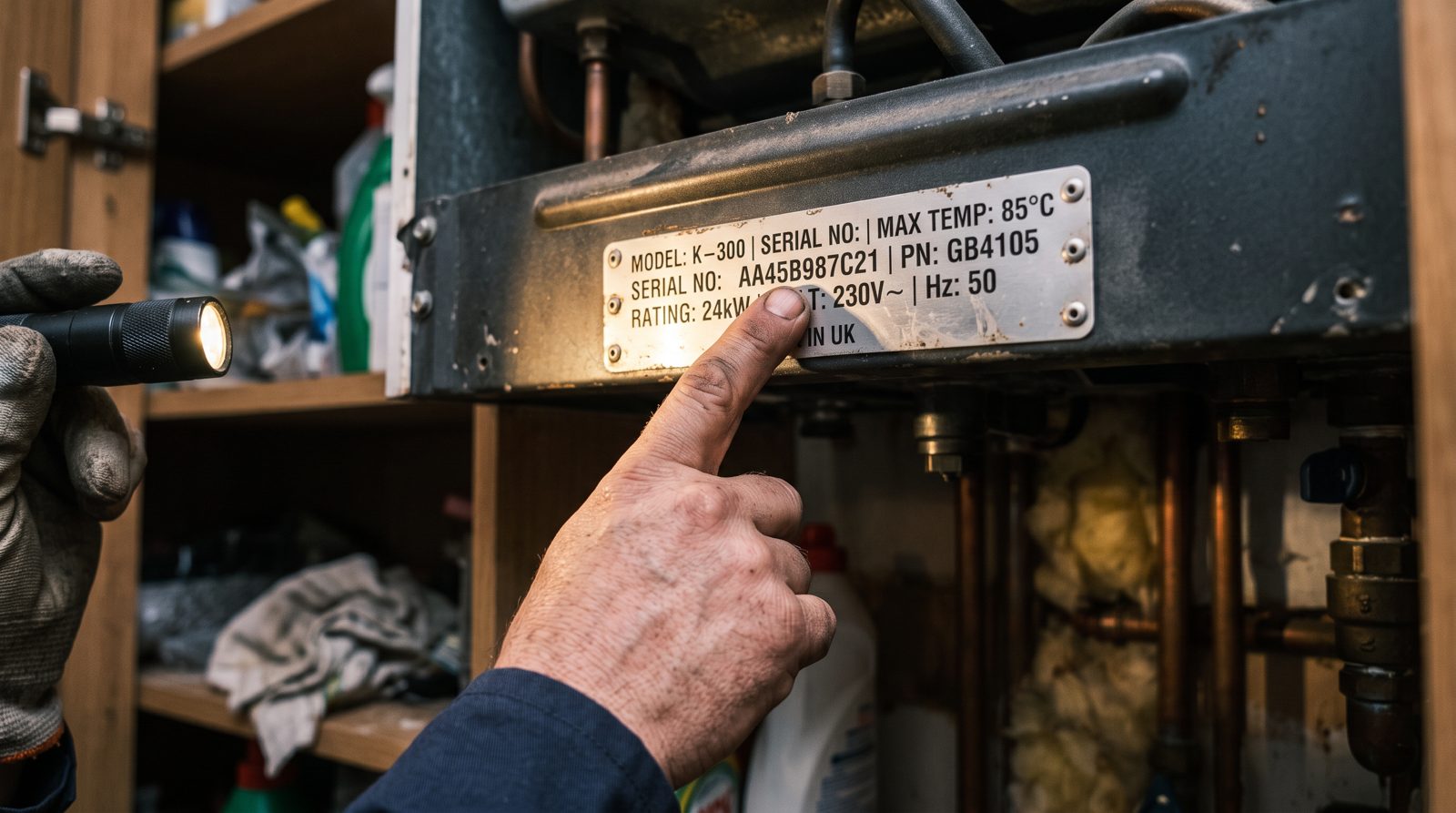
Every boiler carries a data plate with the model name, the serial number and the gas council or GC number. The plate is usually on the underside, behind the drop-down control flap, or inside the casing on the left. The serial number encodes the manufacturing date, and each manufacturer uses a different format:
- Some embed the year and week directly, so a number containing 1712 might mean the twelfth week of 2017.
- Others use a letter code for the year and a number for the month.
- A few use a plain sequential number that only the manufacturer can decode.
Most manufacturers have a page on their website explaining their format, and their customer service line can decode a number over the phone. Bear in mind the manufacturing date can be several months before the installation date if the boiler sat in a merchant’s warehouse.
4. Ask Gas Safe, OFTEC or the council
Gas boilers installed since April 2005 should have been notified to the local authority through the Gas Safe Register, and oil boilers through OFTEC. Both schemes can confirm whether an installation was notified at your address and on what date, and can issue a copy of the Building Regulations certificate for a small fee. Your council’s building control department holds the same records, and it is the only source if the boiler was fitted under a building notice rather than through a scheme. Our guide to the boiler installation certificate explains how to request one.
5. Read the clues on the boiler itself
When paperwork and records fail, the boiler’s design tells you a great deal.
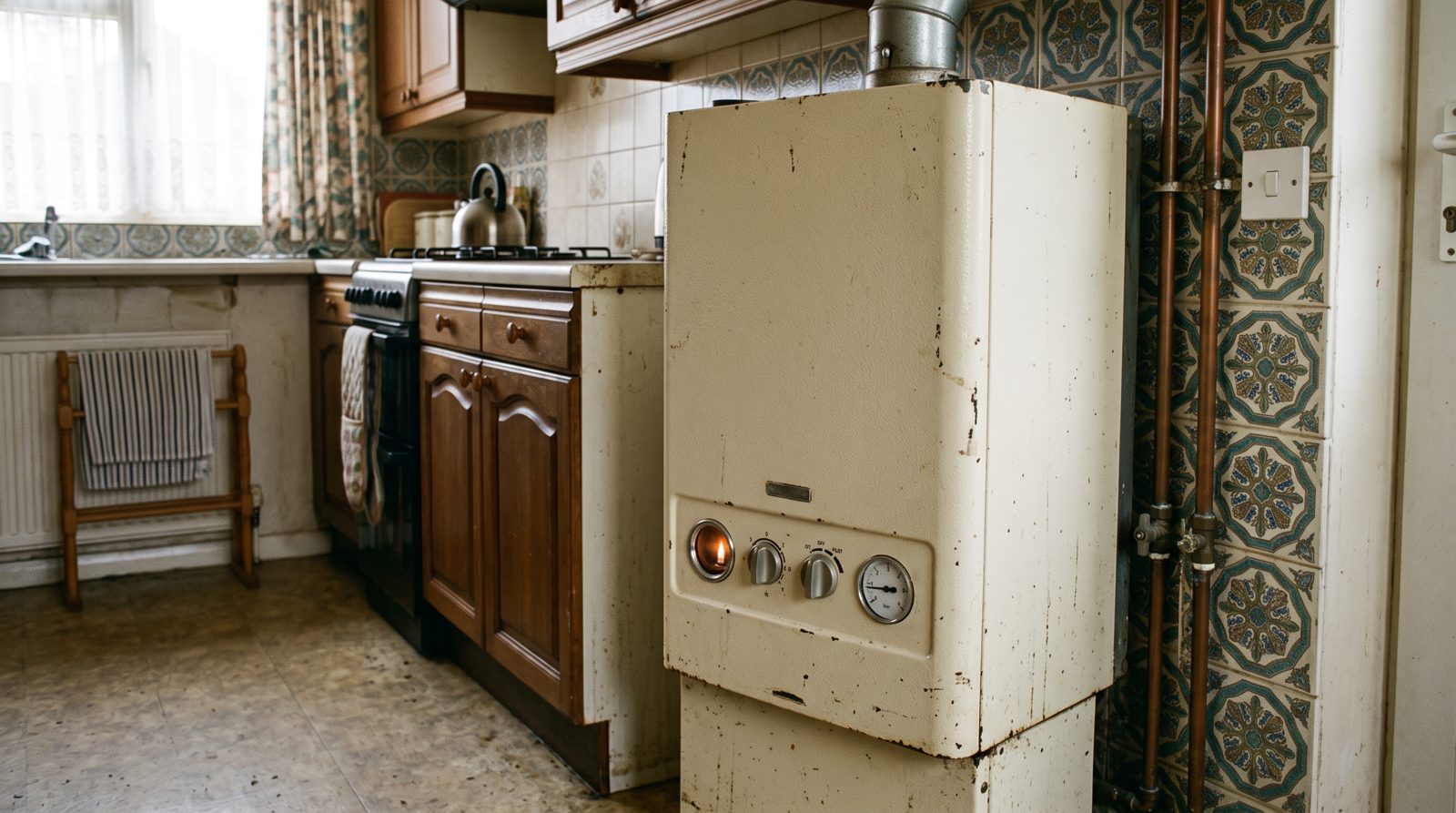
- A pilot light that burns constantly means a non-condensing boiler, almost certainly installed before 2005, when condensing boilers became compulsory for new installations.
- A plastic condensate pipe running from the boiler to a drain means a condensing boiler, so 2005 or later.
- A digital display rather than dials and a mechanical clock generally points to the last fifteen years.
- Floor-standing cast iron boilers and back boilers behind fires are typically from the 1980s and 1990s.
- The model name can be searched online to find when it was in production.
What the age tells you
A boiler under ten years old is usually worth repairing. Parts are available, efficiency is close to a new model and the warranty may still apply. Between ten and fifteen years, the sums get closer: repairs become more frequent, and a modern condensing boiler will use noticeably less fuel. Past fifteen years, and certainly past twenty, the question is rarely whether to replace but when. Our guides on how long a boiler lasts and whether a 20 year old boiler should be replaced go into the decision properly.
How DCI Boilers can help
If you are trying to decide whether an ageing boiler is worth another repair, DCI Boilers can inspect it, confirm its age and condition and give you an honest view. Our boiler servicing visits across Cornwall and Devon include a check of the data plate and a note of the age on your record, and if replacement is the sensible route our gas boiler replacement survey is free.
Need help now? Call DCI Boilers on 07888 862 603 or get a free quote.
Frequently asked questions
Where is the serial number on a boiler?
Usually on a data plate on the underside of the boiler, behind the control flap, or inside the casing. The manual shows the exact position for your model.
Can Gas Safe tell me when my boiler was installed?
Yes, if the installation was notified. The Gas Safe Register can check your address and confirm the notification date.
Does the serial number date match the installation date?
Not exactly. The serial number gives the manufacturing date, which can be weeks or months before the boiler was fitted.
Is a boiler without a pilot light always newer?
Generally, yes. Electronic ignition and condensing technology arrived together in most ranges, so a boiler with no permanent pilot light is likely to be 2005 or later.