
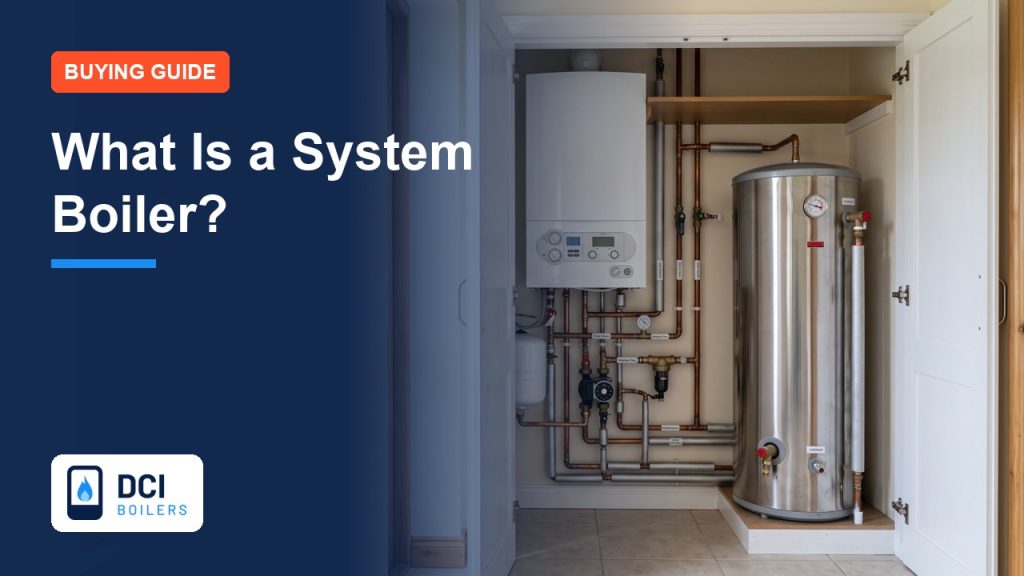
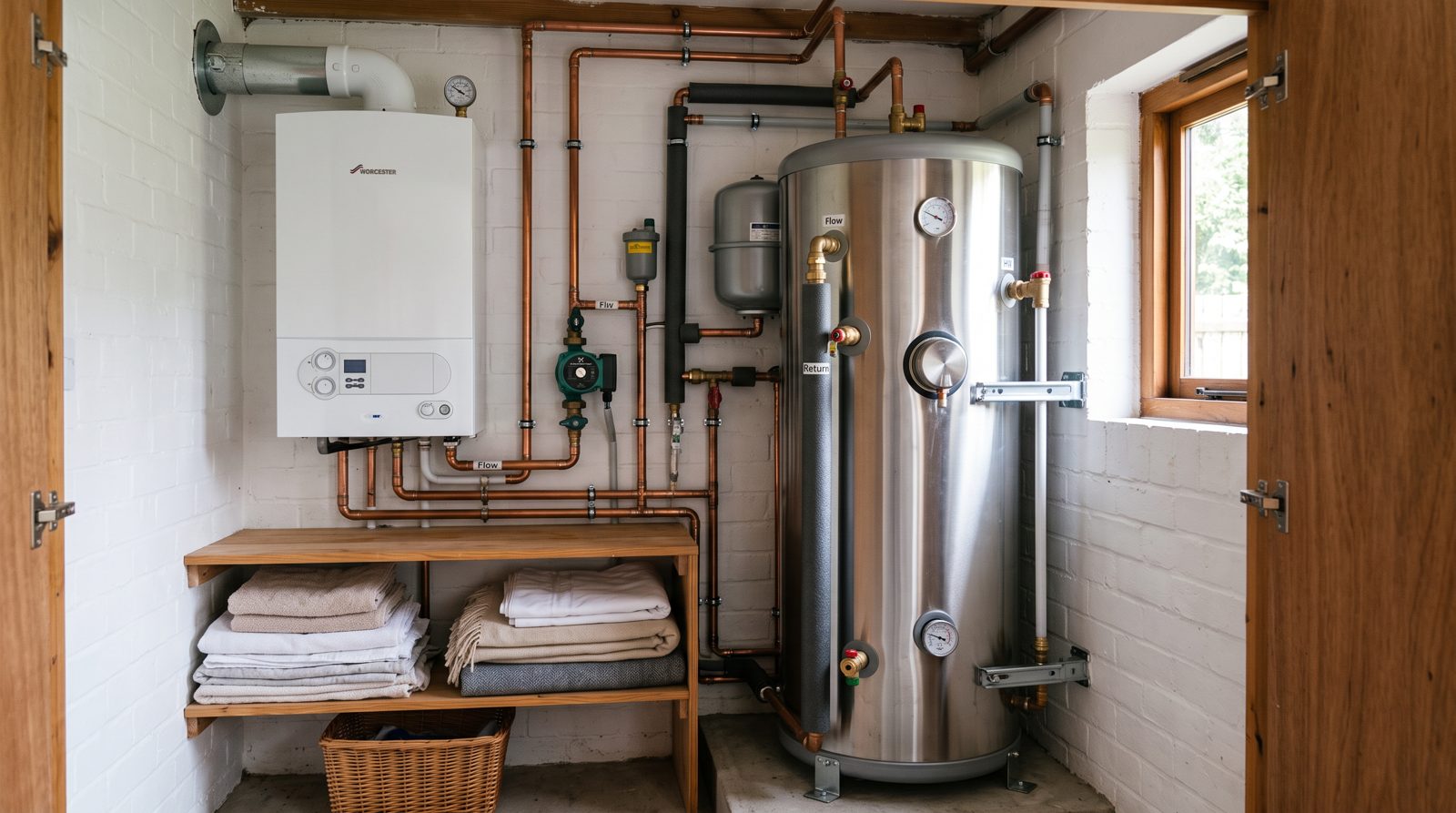
A system boiler heats your radiators directly and heats a hot water cylinder for your taps, with the pump and expansion vessel built into the boiler so there are no tanks in the loft. It sits between a combi, which has no cylinder, and a conventional boiler, which needs both a cylinder and loft tanks. System boilers suit homes with two or more bathrooms, high hot water demand or low mains pressure, where a combi would struggle, and they are the usual choice when replacing an old conventional boiler without going all the way to a combi.
This guide explains how a system boiler works, how it compares with the alternatives, what the cylinder options are and who should choose one.
How a system boiler works
The boiler heats water and pumps it either round the radiators or through a coil inside the hot water cylinder, depending on what the controls are asking for. The cylinder stores hot water ready for the taps, so several outlets can run at once without the boiler having to heat water on demand. Because the pump, expansion vessel and safety valves are inside the boiler, the system is sealed and pressurised, like a combi, and there are no feed tanks in the loft. Cold water for the taps comes straight from the mains.
System boiler versus combi
A combi heats water on demand and has no cylinder, which saves space and means hot water never runs out, but the flow rate is limited by the boiler and drops when two outlets run at once. A system boiler with a cylinder delivers strong flow to several outlets simultaneously, but the hot water can be used up and takes time to reheat, and the cylinder needs space. Our guide to combi versus system boilers compares the two in detail.
System boiler versus conventional boiler
A conventional, or regular, boiler also uses a cylinder, but it relies on a cold water storage tank and a feed and expansion tank in the loft, and an external pump. A system boiler removes the loft tanks and builds the pump in, which simplifies the installation, improves pressure at the taps if paired with an unvented cylinder and frees the loft. Most conventional boilers are replaced with system boilers today unless there is a specific reason to keep an open vented arrangement. Our guide to combi versus conventional boilers covers the older design.
The cylinder: vented or unvented
A system boiler works with either type. A vented cylinder is fed from a loft tank and delivers hot water at gravity pressure, which is fine for baths but weak for showers. An unvented cylinder is fed from the mains and delivers hot water at mains pressure to every outlet, which is why most new system boiler installations pair with one. Unvented cylinders need a G3-qualified installer and an annual check of their safety devices. Our guide to hot water cylinder replacement explains the choice.
Pros and cons
Advantages
- strong hot water flow to several outlets at once
- works well with low mains pressure when paired with a vented cylinder, or gives mains pressure with an unvented one
- no loft tanks, simpler than a conventional system
- compatible with solar thermal and some renewable arrangements via a twin-coil cylinder
- a smaller boiler can suit, since hot water is stored rather than made on demand
Disadvantages
- needs space for a cylinder
- hot water can run out and takes time to reheat
- heat is lost from the cylinder over time, though modern insulation keeps this small
- slightly more to install than a combi
Who should have a system boiler
- homes with two or more bathrooms, or a family that showers back to back
- larger houses with high hot water demand
- properties with low or unreliable mains pressure
- homes replacing a conventional boiler that already have a cylinder cupboard
- anyone planning solar thermal or a hybrid system
Our guide on boiler flow rate helps you judge whether a combi would cope or a cylinder is the safer choice.
Installation
Replacing a conventional boiler with a system boiler is usually a one to two day job: the loft tanks come out, the new boiler and cylinder go in, and the system is converted to sealed and pressurised. Replacing a system boiler like for like is a day. Converting from a combi means adding a cylinder and its pipework, which takes longer. A Gas Safe or OFTEC registered engineer surveys the property first, checks the mains pressure for an unvented cylinder and quotes a fixed price. Our guide to whether fitting a new boiler is a big job explains the timings.
How DCI Boilers can help
DCI Boilers installs system boilers and cylinders across Cornwall and Devon, in gas and oil, with Gas Safe and OFTEC registered engineers, fixed pricing and manufacturer warranties of up to 12 years. We will look at your hot water demand and mains pressure and tell you honestly whether a system boiler or a combi suits your home. Read about our gas boiler replacement and heating services, which cover cylinders.
Need help now? Call DCI Boilers on 07888 862 603 or get a free quote.
Frequently asked questions
Does a system boiler need a tank in the loft?
No. The pump and expansion vessel are inside the boiler and the cylinder can be fed from the mains, so the loft tanks go.
Is a system boiler better than a combi?
For homes with two or more bathrooms or high hot water demand, usually yes. For smaller homes, a combi is simpler and saves space.
Can a system boiler run out of hot water?
Yes, once the cylinder is used up, though a correctly sized cylinder rarely does and reheats in under an hour.
Can I get an oil system boiler?
Yes. System boilers are the most common type of oil boiler and pair well with an unvented cylinder in rural homes.