

Preparing a boiler for winter comes down to a service in late summer, a run of the heating before you need it, a check of the pressure, the radiators and the condensate pipe, and, for oil, a look at the tank and fuel line. Most winter breakdowns are parts that stuck or wore over summer and would have been found in September. Cornwall and Devon winters are mild but wet and windy, with occasional hard frosts, which is exactly the weather that freezes condensate pipes and blows out flames on exposed flues. Here is the checklist.
1. Book the service now
An annual service is the foundation. The engineer cleans and checks the burner and heat exchanger, tests combustion, checks the safety devices, the expansion vessel and the pressure relief valve, empties the magnetic filter and, on oil, fits a new nozzle and filter. It is the single best way to prevent a winter breakdown, and it is a condition of almost every warranty. Late summer is the right time; December is when everyone else rings. Our guide to how long a boiler service takes explains what happens.
2. Run the heating before you need it
Turn the heating on for half an hour on a mild day in September. Pumps, diverter valves and motorised valves that have not moved since spring stick, and it is far better to find out now. If radiators stay cold or the boiler locks out, you have time to fix it. Our guide to heating not working after summer covers what to check.
3. Check the pressure
With the system cold, the gauge should read between 1 and 1.5 bar. Top up if it is low, and note the reading. If it has dropped again in a week, there is a leak or a flat expansion vessel to sort before winter. Our guide to what boiler pressure should be explains the readings.
4. Bleed and check the radiators
Bleed every radiator from the top of the house down, then top up the pressure. Feel each one after half an hour of heating: cold at the top means air, cold at the bottom means sludge, and one cold radiator among warm ones is usually a stuck valve. Our guides to radiators cold at the bottom and one radiator not heating up cover the fixes.
5. Insulate the condensate pipe
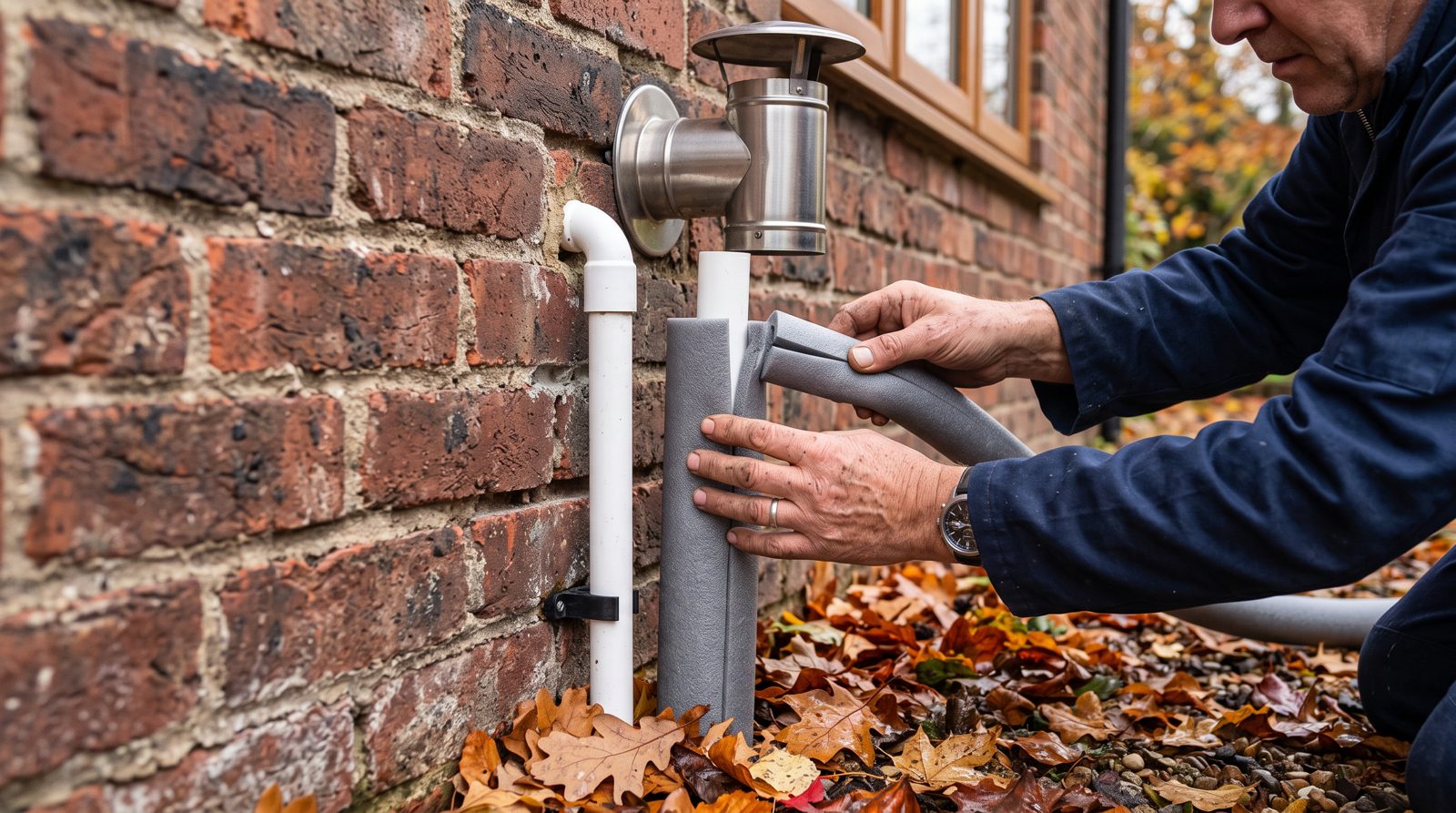
The plastic pipe that carries condensate from the boiler to a drain is the number one cause of winter lockouts. If it runs outside, insulate it with weatherproof lagging, keep the run short, and make sure it falls steadily to the drain. If it has frozen before, ask the engineer about re-routing it internally or fitting a larger pipe. Our guide to a frozen condensate pipe explains thawing and prevention.
6. Oil: tank, fuel line and filter
Check the tank level and order early; suppliers get busy and prices rise in a cold snap. Have the tank checked for water and sludge at the service and the filter replaced. Lag any exposed fuel line and the filter bowl, because kerosene thickens in a hard frost. For an external boiler, check the lagging on the flow and return pipes and never switch the boiler off at the wall, because frost protection needs power. Our guide to external oil boilers in winter covers the detail.
7. Controls and thermostats
Replace the batteries in wireless thermostats, check the programmer’s clock and schedule, and set a sensible flow temperature on the boiler, around 60 to 65 degrees for a condensing boiler. If the thermostat is old, this is the moment to upgrade to a modulating or smart control. Our guide to smart thermostats with a combi boiler explains the options.
8. Flue and outside checks
Walk round the outside and check the flue terminal is clear of leaves, bird nests and vegetation, and that nothing has been stacked in front of it. Check the pressure relief discharge pipe is dry. On an exposed coastal wall, a flue that faces the prevailing wind can lose its flame in a gale; if that happened last winter, ask about a plume kit or a different terminal.
9. Carbon monoxide alarm
Test it, replace the batteries, and check its expiry date; most alarms last seven to ten years. Every room with a boiler, fire or stove should have one.
10. Know your emergency steps
Find the reset button, the filling loop, the stopcock and, for oil, the fire valve now, while it is light and warm. Keep the boiler manual where you can find it. Our guides to how to reset a boiler and whether a broken boiler is an emergency are worth a read before you need them.
How DCI Boilers can help
DCI Boilers services gas and oil boilers across Cornwall and Devon with Gas Safe and OFTEC registered engineers, checking the condensate route, the expansion vessel, the tank and the controls as part of every boiler servicing visit. Book in September and pick your date. If something fails in the cold anyway, our emergency boiler call-out runs around the clock, and if the boiler is past saving, our gas boiler replacement and oil boiler replacement surveys are free.
Need help now? Call DCI Boilers on 07888 862 603 or get a free quote.
Frequently asked questions
When should I get my boiler serviced before winter?
Late summer or early autumn. Engineers have space in the diary and any fault is fixed before the cold.
Should I leave the heating on low over winter?
In a hard frost, a low background setting overnight keeps water moving and pipes above freezing. The rest of the time a normal schedule is fine.
What is the most common winter boiler fault?
A frozen condensate pipe. Insulating it in autumn prevents most of them.
How much oil should I have in the tank for winter?
At least half full going into December, and reorder at a third. Running low lets air and sludge into the fuel line.